Showing posts with label clothes/indumentaria. Show all posts

Sunday, July 31, 2011

Fiesta de San Ignacio de Loyola

I nearly forgot. On our way back from a walk today, we reached our parish church as the mass ended, and a few minutes later, some Ecuadorian members of the congregation came out of the parish hall, and danced, while everyone else looked on. July 31st is the feast of San Ignacío de Loyola, founder of the Jesuit order. Maybe there are lots of Jesuits in Ecuador? I don't know, but the women looked lovely in their embroidered blouses, with their shawls pinned to their huge straw hats.

I took one of the men for a morris dancer at first, because of his beribboned hat, except that I've never seen a morris man in a poncho and llama fur trousers. On the other hand, I never thought I'd see a devil figure, second-cousin to a Morris Fool or Beast, as master-of-ceremonies outside a Roman Catholic church, with the parish priest and congregation enjoying the show! We know the Spanish took Christianity to 'Latin' America: interesting to see that the cultural traffic isn't all one way.

Sorry some of the pics are a bit blurry, but I felt intrusive enough waving a camera behind the congregation. I wasn't about to weave through to a decent vantage point! And I'm not 100% sure I've got the right nationality (again - gatecrashing tourist) but I've searched online and in my precious Worldwide History of Dress, so .....90%?! If anyone can reassure me, or correct me, I'll feel much better!


While everyone else chatted, and waited to start, the man on the right gave the - fool? - devil? - a few pointers on his moves.


Thursday, September 04, 2008

Tuesday, November 20, 2007

Designs of the times?


In today's Guardian:


Running under cover


Fewer than one in five women do enough exercise, and many Muslim women are among them. But, says Peta Bee, with specially designed sportswear and single-sex classes on the rise, this could soon change.


.....Muslim societies, in general, do allow women to exercise; in fact, Islam positively encourages physical activity for both sexes. But, in some Muslim communities, female participation in sport and fitness is permitted only on the condition that women adhere to their religion's code of modesty. And for many Muslim women, outside of school PE lessons, there is little opportunity to exercise. For some women, swimming in public pools is not an option, and neither is any activity where men will be present......


Rimla Akhtar, chairwoman of the Muslim Women's Sports Foundation (MWSF), based in Harrow, says: "Religiously, there is still concern that sport is wrong but there are definite signs that this is being overturned with the younger generation." Every week, the MWSF runs two-hour training sessions in north London, which attract budding female footballers from as far afield as Leicester and Leeds. And at the East London Mosque, the Hayaa Fitness Centre holds yoga, kickboxing and other similar sessions. Zaynab Shirji, 23, who works out regularly there, says that the difficulties of finding a suitable fitness venue "mean that in the past many Muslim girls ended up doing nothing. There are still relatively few places Muslim women can get fit."


In Birmingham, the Sisters Games initiative, launched last year, provides Muslim women with single-sex sporting opportunities and exercise classes that allow them to adhere to Islamic values. Akhtar says a huge breakthrough was made when Britain became the first non-Muslim country to take part in the Muslim Women's Games, a four-yearly championship run like a mini-Olympics. Many of those who took part in the 2001 and 2004 competitions, including Akhtar, say they were inspired to take up sport by the emergence of elite Muslim women athletes from other countries. High-profile role models include Nawal el Moutawakel of Morocco and Hassiba Boulmerka of Algeria, both Muslims who have won Olympic track golds. Boulmerka was often forced to train outside her country after being criticised there for training in athletic vest and shorts.

.............................


For further evidence that a cultural shift is imminent, look to the £160bn-a-year global sportswear industry, which has started to turn its attention to the spending power of the 650 million women who practise Islam.


...........................


Meanwhile, an Australian designer, Aheda Zanetti, has come up with the so-called burqini - a two-piece bathing suit. Struggling to cope with demand for the outfit, Zanetti says it has been adopted by Australia's new Muslim women lifeguards and some swimmers with Olympic potential.


Zanetti has also developed what she calls a "hijood" - a hijab shaped like a hood. She explains: "As an active young Muslim girl I found it difficult to participate in most sports because of all the excess clothes I had to wear" ·

Tuesday, August 28, 2007

Las Verbenas de la verana

We are currently based in central, older Madrid, where dozens of churches - and palaces and you name it! - date from the 17/18/19th centuries. Church and State are now separate in Spain, and with Franco long dead, there’s religious tolerance and freedom of worship, so although I’ve seen no mosques, temples or synagogues here in the centre, I’ve passed Hindus and Muslims in the street, heard Arabic and Hindi, seen a halal butcher, and heard the call to prayer over the radio in Iraqi shops, coffee shops and import businesses. No doubt there are mosques and temples in the more recently built suburbs. In the centre, though, I’ve seen streams of perfectly groomed middle-aged and elderly Madrileños going to and from mass each Sunday.

Arriving at the beginning of August, we have been here for the verbenas de verano. I was puzzled when I got here, because I knew lemon verbena as a herb, and why were they celebrating summer (verano) herbs? Here, a verbena is a local religious festival for the patron saint of a particular area, and August is Madrid’s verbena month, with masses, processions and streets decked in bunting in honour of San Cayetano, San Lorenzo, and the Virgen de la Paloma.

San Cayetano is the patron of Lavapiés, the old Jewish (and then Jewish convert) barrio, now with a largely student and foreign population. It’s cheap, laid back, and we like it, especially the pay-as-you-go locutorios, the ever-open Argumosa Librería (new & secondhand bookshop), the handy Carrefour supermarket, and the Economico café, where you can sit out, eat excellent food served by friendly staff, and watch the world go by over a caña of beer or a vaso of good Spanish wine. We also like the sidrería across the road, where they demonstrated how to pour a bottle of Asturian cider. Never seen anything like it! More on that another day, when they get back from their holidays, and I can take some photos: they’ve been ‘cerrado por vacaciones’ since the end of the street party for the San Cayetano verbena, around August 7th.

On August 11th (San Lorenzo) we had just moved into our flat and were in recovery mode after a week’s sight-seeing and flat-hunting in Spanish at 36°C, so we missed that one. All I know is that it started as a celebration for a naval victory a few hundred years ago.

However, I picked August 15th to try the public library next to Puerta de Toledo, and arrived there at 8.30, opening time. No sign of life – no problem. After a café sólo and tostada con aceite (toast and olive oil – Butter is not common here, except, I suppose, in green, wet Galicia with its dairy herds.) I pitched up at the library again, this time at 9 o’clock. Nada! It turned out that this was the actual Verbena de la Paloma; the Virgen was the patron of the neighborhood, and of firemen. Her church, and the local fire station, were both just across the way; and everything was shut for the fiesta. The library would be open the next day. I phoned Habibi, and he came down with camera, and we went over to the Plaza de la Virgen de la Paloma.

La Virgen de la Paloma. This painting had been hung above the entrance to a cervecería.


The base of the float. Later on, the massive, gilded altarpiece will be brought out of the church, mounted on this base, banked with flowers, and with its (newly checked) electric lamps blazing, carried through the streets in procession at 8 p.m.


The rear of the float


And another piece in raw wrought iron. Perhaps to do with the fire service?


Perhaps a fireman created this personal display on his balcony, in honour of the patron of the fire service. 'Patrona de los Bomberos. Muchos Salvar'


The fire station is just around the corner from here.


Creating flower panels. The church had been open since the previous evening for offerings of cut flowers, and people continued to arrive with sprays of flowers. All through the first mass of the day, these two Madrileños in traditional dress, and a changing team of helpers, tucked the flowers into the mesh panels, ready for the evening procession


A reminder of the 'dons' of Spanish history. Deacons, perhaps? Police are a familiar and reassuring sight here. They're all very relaxed, just always around.


An entire building dressed for the occasion. These balconies are draped in green satin, overlaid with white gauze, with an arrangement of flowers on each one. Devotion.


Fiesta time. The apartment building on the left is being restored and modernised, as are many such buildings, making coloured tarpaulin our all-year-round bunting. Round the corner, the street is lined with food and drink stalls that stay open far into the night during the fiesta. When I walked down that morning, unaware of the fiesta - and all-night street parties - I was appalled at the litter-strewn streets, and abruptly crossed this neighborhood off my list for permanent-flat-hunting. The next thing I knew, the Medio Ambiente guys had swung into action with brooms, hoses, trolleys and trucks, and there was water running down pavements and roads. And everything was back to normal. Very impressive.

Local dress is not merely fancy dress, or only worn by the middle-aged and elderly.


I was intrigued by this man's pipe, which has a hinged lid! He was phlegmatic about being photographed. There was another man, in a rather battered black top hat and black tailcoat, whose sideburns struck me as rather improbable - yup - glued on for the occasion!


This gypsy woman and her barrel organ are usually parked in one of the shopping streets off Puerta del Sol, but she was down here early, if not bright.


There was a big tent outside the church, with chairs and tables laid out. This man is squirting closed horseshoes of dough into hot oil to make churros, an Andalucian doughnut. The doughnuts - the blandest thing I have ever tasted - are dipped in Andalucian hot chocolate - hot, liquid chocolate, not to be confused with drinking chocolate. Alright if you like that sort of thing.....


Variations on a theme.


And this, gratefully borrowed from another blog , is the actual float of La Virgen de la Paloma, being carried through the streets of Madrid on August 15th. She stopped traffic for a couple of hours.

Saturday, September 09, 2006

Paper Dresses

Yes really.

I'm researching costume for The Merry Wives of Windsor, which I want dressed in a cross-over between English fashions of the late 1600s and the 1950s (1590s meets 1950s). This is not as nuts as it sounds.

No really!

And surely not as nuts as paper dresses? It seems that Scott Paper (now Kimberly Clark) came up with the idea as a sales giggle gimmick in 1966, and the crowd went wild!


Here we have their charming little Op Art number, 'The Paper Caper'. "created to make you the conversation piece at parties. Smashingly different at dances or perfectly packaged at picnics. Wear it anytime...anywhere. Won't last forever...who cares? Wear it for kicks -- then give it the air."


Interested? Get a pattern here.


And how about a matching mother and daughter set? Ladies, you'll look gorgeous!


And Gentlemen, with a little ingenuity you too could have that perfect garment for Bolognese Night, practising your chopstick technique, or the Satwa Sommeliers' initiation soirée.

So, hardly crazy at all really. Not really.

Thursday, April 13, 2006

Ramallah 2


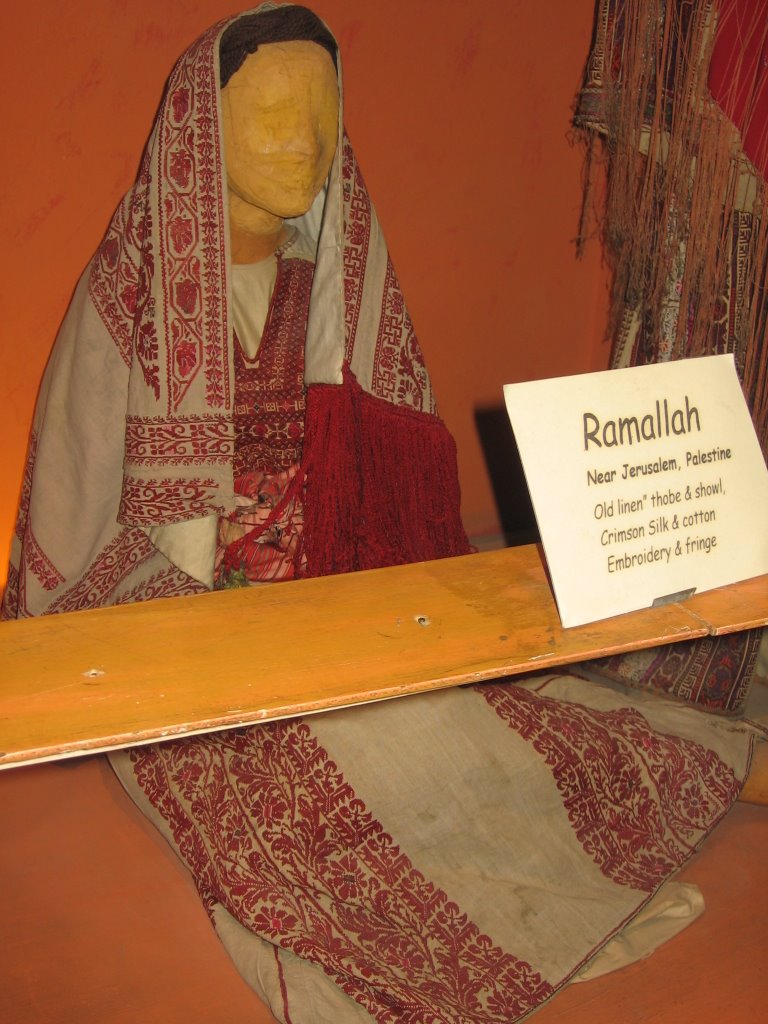
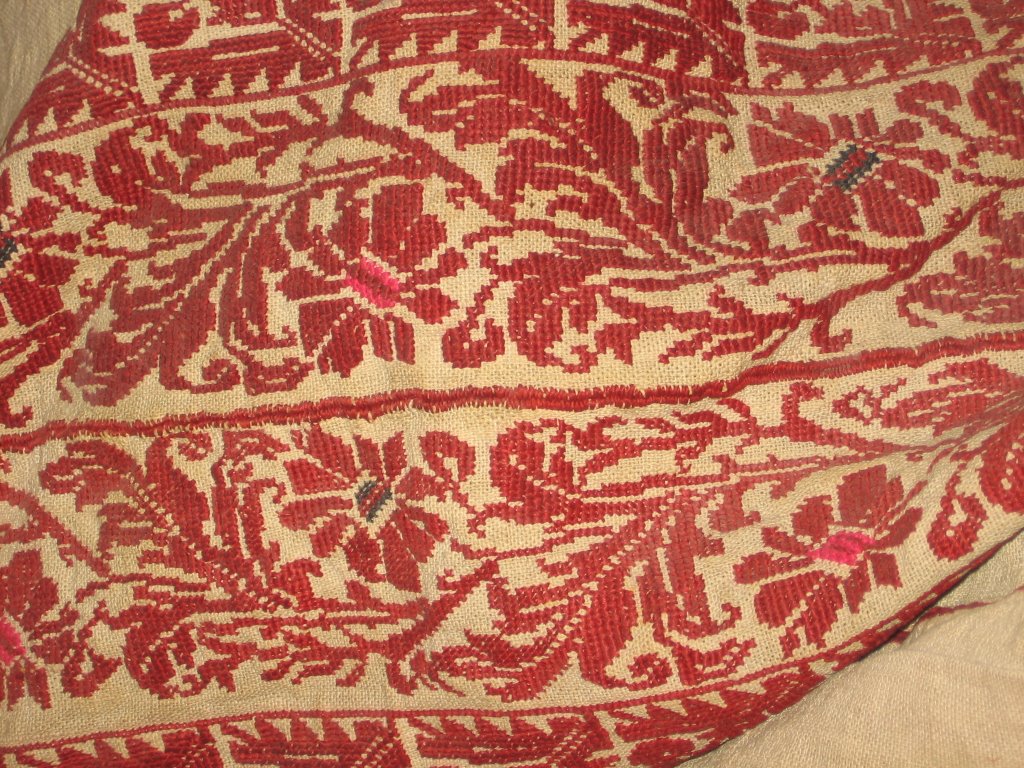
Last one! The close-ups are clear enough to copy or adapt, and if you feel inspired but are no good without graph paper, you will really enjoy the Palestinian embroidery site I mentioned earlier. There are borders of checks, teeth, feathers, flowers and vines, and the large-scale border designs of birds and flowers similar to the one on in the other Ramallah entry.


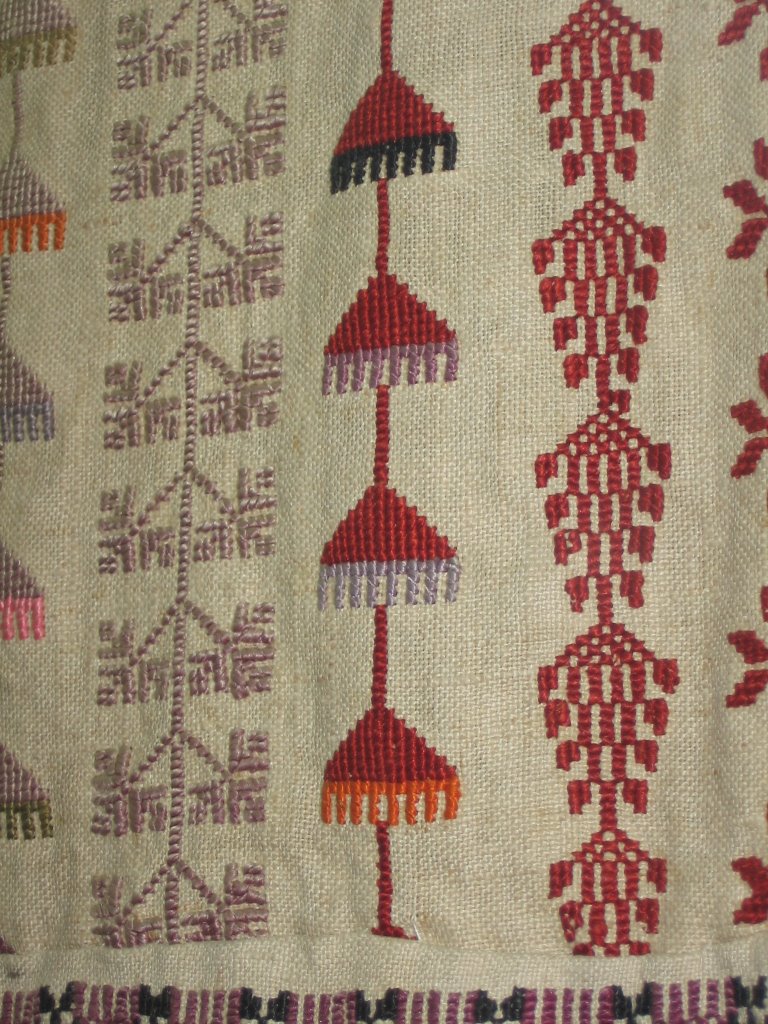
The trellis centre left is 'eastern one'. Then come two symmetrical rows of 'saw', and then 'stick' (There are also wider stick borders.)

I like the combination of chequered triangles and variations on cypress tree.


The multicolour star is 'millwheel' with a toothed border.


This last photo is a close-up of the ghudfeh you can see hanging (upside down, I think) on the far right of the first pic.
A ghudfeh is a rectangular head-shawl made of three narrow woven strips sewn together.
Here is saru again, and this enchanting silver grey flower border with each flower head similar to riish. I don't know what they call the other motif, but as long as it's upside down, I'm calling it 'lampshade'.

The reason I took so many photos in Amman's fascinating National Folklore Museum is that I haven't seen any books on Palestinian costume here, although there are plenty of thobs and shawls to choose from, as well as lusciously embroidered Kashmiri jackets, coats and pashminas. Ooh! I bought Jehan Rajab's book at the Museum, and Shelagh Weir's has been republished - look out for them for the cultural background and stories as well as the pics.

I'm putting these pics up partly because they are too beautiful to be hidden away, and partly as a record of a part of Palestinian culture, something precious that is overlooked nowadays. It is under extreme pressure, and no doubt much has been irrevocably lost, except among the diaspora.

Ramallah


Another favourite - OK, so we know I love colour, skill, and the assumption that beauty is as essential to human life as food, shelter, clothes and friendship.


Beer Sheba 2


Back with the Jordanian bedu. Isn't this fab? (Sorry about the flash, but it was behind glass and I couldn't get the right angle.)

Unlike villagers from anywhere else in Palestine, the bedu favoured long bat-wing sleeves whose points almost reached the ground. The tips could be tied behind your back to get your sleeves out of the way for practical work, or flipped up over your head for shade. JR says that the colour yellow was often used as protection against the evil eye, as well as for its cheerfulness.


No Idea 3 (Dubedubedu)

I think these are both Bedu, but does anyone know for sure?

I thought at first that the garment on the left was a tunic, worn over a thob with two rich blue borders, but but it's a thob'ob - and so is the one on the right! Colour!


The coloured florets look to me like either couched or machine stitched embroidery yarn.


Eight point star and cypress tree

Wednesday, April 12, 2006

No Idea 2 (Dubedu)

AK has a photo of a Bedu thob'ob from the Tareq Rajab Museum in Kuwait, in similar colours to the thob on the left - but about 3m long! I don't have anything on the blue thob, but I love those tassels (Urgh - flies - urgh. Tassels are functional as well as fun.)


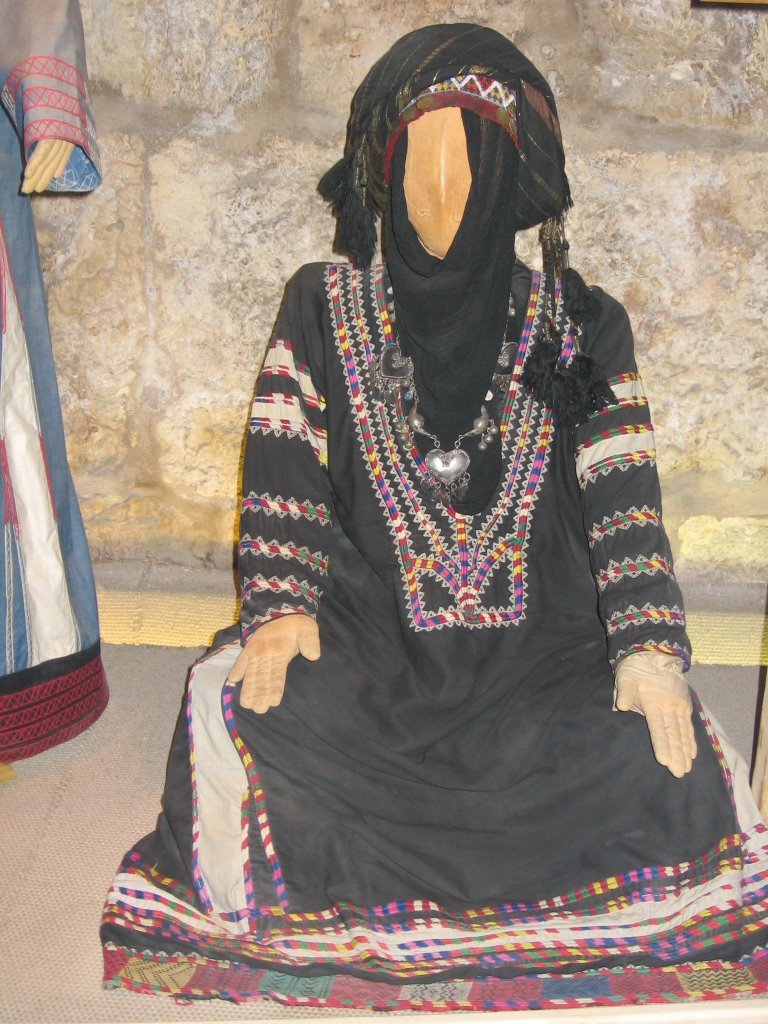
AK identifies something very similar to this (black with white panels and this style of embroidery) as perhaps coming from the Harb of the Hijaz, one of the mountain ranges on the KSA side of the Red Sea coast