The good thing about a multicultural city like this (and I mean multicultural, there's contact and cross-fertilisation but no melting pot) is that sooner or later your phonebook and email contact page looks like something out of the UN directory. When you have regular contact with people from Lebanon, France, India, Ukraine, South Africa, the Philippines, Egypt, Scotland and Mexico, stereotypes begin to lose their power, and foreign ways become part of your landscape. I'll pass on Fatma's cardamom coffee, Rafael's gazpacho, and Hamad's mutton mansaf (arghgh!) and let you off peasepudding, haggis (Don't ask..) and Merlot. Eid, Diwali and Bonfire Night all within a week of each other? OK. Let's do our own thing, but enjoy everyone else's lights and fireworks too. Ramadan Kareem to you. Happy Christmas to me. It works here. We grumble about the bits we don't like, may be wary of the unfamiliar for a time, may find someone's cooking, religious observances or family traditions incomprehensible, but if it works for them, and ours works for us, then that's ok.
But it would be good if we could have a national standard on time management, some kind of protocol, like a published table of relative time to assist in cross-cultural appointment making, so that if you tell me 2pm I know you mean GMT, GMT+/-3/4/7, bukhara, insha'llah, toute de suite, mañana baby or in your dreams buddy!
Arab culture is very much about family, often an extended family. Even here in Dubai, where Emaratis live further apart than they used to and are outnumbered nationally by something like 85% foreigners, 75% from the sub-continent, and the rest of from all over the world (not sure, especially after recent expansion, but I've heard these sorts of numbers) family ties remain important, and people can place second cousins, aunts and nephews. I can do that up to a point, but there's no comparison. (I was reading a Spanish blogger who explained that, because women keep both their mother's and their father's surname on marriage, she can trace her relatives through four generations on both sides.)
Even in a social and cultural oddity like Dubai which is part New Town, part family business with global expansion plan, local culture remains family orientated, private. This, in a world with a global-information culture governed by the assumption that everything is or should be open to public view and tourism.
Here we routinely grumble about one another from time to time, and get on with it - isn't that the point of grumbling - a little grease to ease the axle? But when people elsewhere look at middle eastern culture (as in contemporaray life rather than heritage), there's not a lot to see, apart from exposés of hideous abuse and honour killings. Yes these happen, far, far too frequently, and it is important that they are reported because that's how ideas shift, consciences stir, and change begins - just as in Britain after poor Damilola Taylor was murdered by racist fellow students, and in Spain, where the tragic suicide of 14 year-old 'Jokin' has at last forced public awareness and official recognition of bullying in schools.
In KSA and here in the UAE private efforts are being made to curtail domestic abuse, through education, legal action and the provision of shelters, and while there is also opposition to all this, and the effort is piecemeal at this stage, attitudes and provision are changing. KSA presenter Rania al-Baz made international headlines last September when she showed her battererd face on TV after another severe beating from her husband - and said that 1) she was not the only wife this was happening to, and b) it was WRONG and what was to be done about it?
Here in Dubai, a newspaper article around about the same time (perhaps as a result?) on a shelter for battered wives, caused outrage among men and women, some of whom sympathised with the wives and condemned the husbands for brutality and betrayal of religious principles, and others who condemned the wives for their betrayal of family values and religious principles. The other immediate outcome was that disgruntled husbands were able to identify the shelter and go after their wives. The shelter relocated amidst continued public debate, which is increasingly supportive of the principle that a women should not live in fear of her husband, and that the 'rule of thumb' (A husband may beat his wife with a stick no wider than his thumb.) is outmoded. Newspaper coverage and debate continue.
In fact, despite the constant criticism of the local press, some of which is dire, it has come a long way in the last five years. In the past, as a public watchdog its best trick was bark, wag and roll over. Actually, forget the bark, because the occasional snap got journalists on the next plane out of here.
Nowadays there is proper national and international news coverage; there are features on contentious social and economic issues (and we certainly have plenty of those); there is public debate. And if you're not satisfied, you can get major international broadsheets at the supermarket, switch on a satellite news channel in virtually any major language, or go online.
So yes, the bad things you hear about are generally true, but they are not the whole truth by any means. Arab girls pursue degree courses, work for a living and run their own businesses in the UAE and Oman - and no doubt in Qatar, Bahrain, Jordan, Syria and Lebanon. KSA, Afghanistan and Iran are topical, not typical! Of course it isn't perfect over here. But where is it perfect?
Sunday, April 16, 2006

By the way
Does anyone else find it ironic that the exercise of Democracy foisted us with Dubbya and Ahmedinejad at the same time? It's all very well to talk about making the world safe for Democracy (not a phrase I've ever entirely understood) but it seems to me that someone needs to examine how Democracy can be made safe for the world! :)
Saturday, April 15, 2006
International and Personal
OK, this started out as a postscript to an earlier blog, but got too long, so I moved it here, but now – let’s face it, the woman wants to talk! So I’ll split it up and you just stop when you’ve had enough! I go back to work tomorrow so that will shut me up for a while.
We are shaped by experience as well as our own culture and family. As an educated but rather unsophisticated woman of limited political understanding (Just call me a bleeding heart liberal.) who hails from an idiosyncratic island and former colonial power off the coast of mainland Europe (The Continent - I love the absolute certainty of that phrase. Hello World, here we are!) living in the middle east, and particularly in Dubai, through a dozen years of globalisation, political, economic and military brinkmanship, alarming climatic change, increasing muslim and christian fundamentalism, and an increasingly deadly intercontinental, inter-religious, inter-cultural struggle for power, prestige, moral high ground - and survival - I have to say that my perspective has been shaped by all this - even if I don't understand it, and have no clue how we are to get out of this mess.
But I have also been shaped by exposure to the day-to-day life of people of umpteen different cultures. With what may be stereotypical English reserve, or a bad case of Roman Catholic female I'm-not-bothering-you-am-I? syndrome, I was at first overwhelmed and dogged by a sense of unworthiness at the warmth and hospitality of Arab and Iranian friends and neighbours who have almost dragged me over the threshold when I've popped round to say hi, who have brought out every sweet (My teeth! I have to develop some won't power or else stay home!), offered every kind of juice, tea and coffee, enquired after the health and well-being of every member of my family, and treated me as the most welcome and honoured friend. Wow. God bless them every one.
On the other hand, early tail-wagging eagerness to mix with neighbours and see my small son make friends first, and leave cultural analysis til he was older, was somewhat discouraged by the recognition that for many asians here I am a Brit - a non-acronym for spoilt-and-supercilious -(i.e. female)-educated-western-economic-interloper-from-former-colonial-power. It is not overt or particularly intentional, but given the racial inequities of the job market here, and the fact that for many people here the legacy of colonialism remains real, it's understandable. Plus there's the Jumeirah Jane syndrome which turns Mrs Ordinary from a small house in England into 'Madame', the bored lady of leisure, living in Jumeirah on her husband's employment package.
(Before Dubai embarked on its bigger-shinier-wackier-most exclusive development programme - who is it that they want to exclude, do you suppose? - Jumeirah was Dubai's elegant upmarket suburb - actually, its only suburb!)
Of course the JJ is a cliché and, as such, often masks culture shock, homesickness, and a feeling of purposelessness because school hours and holidays, combined with Jumeirah Jim's long hours and frequent business trips, mean that educated, sociable Mrs Ordinary can't work outside the home if she wants to look after her children, so what does she do when they're at school and JJ's at work, and how does she make friends? But she's white, has the 4x4 and the big villa, drinks latté and complains about the maid to her friends who are all manicured, pedicured and coiffed to the beautifully bronzed hilt, and I'm so jealous I could spit!!!!!!!!!!!!! Naturally, to all the under-paid, frequently over-qualified, Filipinas, Pakistanis, Sri Lankans and Indians providing the pedicures and serving the lattés on ten-hour shifts, being a Brit looks pretty good.
Anyway, the times they are a-changing, the buildings are going up almost as fast as the rents, and the salary+accommodation+school fees+annual flights home package will soon be history, so I guess that equality is coming because Mr and Mrs JJ can't afford to stay here much longer, so unless there's someone else out there looking for maids, pedicures and caffeine, there are going to be several agencies, salons and Starbucks franchises on the market, and several million m.sq. of valuable commercial and residential real estate available from Golden Goose Enterprises.
Enough already. As I say, JJ is a cliché, a stereotype; and stereotypes are so seductive in the short term, so dangerous in the long term.
We are shaped by experience as well as our own culture and family. As an educated but rather unsophisticated woman of limited political understanding (Just call me a bleeding heart liberal.) who hails from an idiosyncratic island and former colonial power off the coast of mainland Europe (The Continent - I love the absolute certainty of that phrase. Hello World, here we are!) living in the middle east, and particularly in Dubai, through a dozen years of globalisation, political, economic and military brinkmanship, alarming climatic change, increasing muslim and christian fundamentalism, and an increasingly deadly intercontinental, inter-religious, inter-cultural struggle for power, prestige, moral high ground - and survival - I have to say that my perspective has been shaped by all this - even if I don't understand it, and have no clue how we are to get out of this mess.
But I have also been shaped by exposure to the day-to-day life of people of umpteen different cultures. With what may be stereotypical English reserve, or a bad case of Roman Catholic female I'm-not-bothering-you-am-I? syndrome, I was at first overwhelmed and dogged by a sense of unworthiness at the warmth and hospitality of Arab and Iranian friends and neighbours who have almost dragged me over the threshold when I've popped round to say hi, who have brought out every sweet (My teeth! I have to develop some won't power or else stay home!), offered every kind of juice, tea and coffee, enquired after the health and well-being of every member of my family, and treated me as the most welcome and honoured friend. Wow. God bless them every one.
On the other hand, early tail-wagging eagerness to mix with neighbours and see my small son make friends first, and leave cultural analysis til he was older, was somewhat discouraged by the recognition that for many asians here I am a Brit - a non-acronym for spoilt-and-supercilious -(i.e. female)-educated-western-economic-interloper-from-former-colonial-power. It is not overt or particularly intentional, but given the racial inequities of the job market here, and the fact that for many people here the legacy of colonialism remains real, it's understandable. Plus there's the Jumeirah Jane syndrome which turns Mrs Ordinary from a small house in England into 'Madame', the bored lady of leisure, living in Jumeirah on her husband's employment package.
(Before Dubai embarked on its bigger-shinier-wackier-most exclusive development programme - who is it that they want to exclude, do you suppose? - Jumeirah was Dubai's elegant upmarket suburb - actually, its only suburb!)
Of course the JJ is a cliché and, as such, often masks culture shock, homesickness, and a feeling of purposelessness because school hours and holidays, combined with Jumeirah Jim's long hours and frequent business trips, mean that educated, sociable Mrs Ordinary can't work outside the home if she wants to look after her children, so what does she do when they're at school and JJ's at work, and how does she make friends? But she's white, has the 4x4 and the big villa, drinks latté and complains about the maid to her friends who are all manicured, pedicured and coiffed to the beautifully bronzed hilt, and I'm so jealous I could spit!!!!!!!!!!!!! Naturally, to all the under-paid, frequently over-qualified, Filipinas, Pakistanis, Sri Lankans and Indians providing the pedicures and serving the lattés on ten-hour shifts, being a Brit looks pretty good.
Anyway, the times they are a-changing, the buildings are going up almost as fast as the rents, and the salary+accommodation+school fees+annual flights home package will soon be history, so I guess that equality is coming because Mr and Mrs JJ can't afford to stay here much longer, so unless there's someone else out there looking for maids, pedicures and caffeine, there are going to be several agencies, salons and Starbucks franchises on the market, and several million m.sq. of valuable commercial and residential real estate available from Golden Goose Enterprises.
Enough already. As I say, JJ is a cliché, a stereotype; and stereotypes are so seductive in the short term, so dangerous in the long term.
Friday, April 14, 2006
Gross National Happiness
Late last year I saw a BBC documentary on Bhutan, and was greatly taken with the government minister who was completely serious about pursuing Gross National Happiness. Yes! (I found this site that gives a bit of background.) Bhutan is at a critical point in its existence as it moves towards signing on the dotted line with the WTO, (has perhaps already done so - haven't checked) and national culture engages with free market economics. Bhutan is no Utopia (In your dreams, foolish mortal!), but its cultural identity and way of life have evolved over centuries. How will these fare as Bhutan joins the global village?
From what I see, market economies are generally unkind to rural communities and rapidly developing cities are hard on the human spirit.
(My 18/19th Century frame of reference is largely European, but in the 20th Century I think that it applies all over the place.)
In addition, contemporary 'urban culture' is more a manifestation of capitalism than an expression of human creativity and community identity; certainly a major element seems to be the economic exploitation of the spending power, restlessness and thirst for identity of teens and young adults. Then there's 'cultural colonialism', beginning with the identification and development of potential new markets for the 'urban culture' product - a key characteristic being malleability: 'Have a MacArabia ®. Would you like fries with that?' So much for cultural identity. (I know everyone takes potshots at McDonalds these days - which I suppose is the drawback of having an internationally successful brand - but it just happens to be the first name to pop into my head, probably because there are two new McDonalds drive-thrus in the 20-minute drive between home and work.)
I remember travelling from city to city in England 25 years ago, and realising that every high street and city centre had begun to resemble every other, both architecturally and in terms of 'high street names'. Now one can enjoy the international deja vu tour.
Hey, rising GNP good! Employment, education, healthcare, social and political stability - good, good, good, good, good! (And, by the way, communism bad except on paper.) But with a world of haves and havenots in which, ironically, a lot of the haves don't seem very happy, perhaps we should be examining our social and economic model? Anyway, I find it admirable that the government of a small nation like Bhutan has the nerve to step up to the plate for necessary economic development, and do so waving the banner of Gross National Happiness.
Good luck to them.
From what I see, market economies are generally unkind to rural communities and rapidly developing cities are hard on the human spirit.
(My 18/19th Century frame of reference is largely European, but in the 20th Century I think that it applies all over the place.)
In addition, contemporary 'urban culture' is more a manifestation of capitalism than an expression of human creativity and community identity; certainly a major element seems to be the economic exploitation of the spending power, restlessness and thirst for identity of teens and young adults. Then there's 'cultural colonialism', beginning with the identification and development of potential new markets for the 'urban culture' product - a key characteristic being malleability: 'Have a MacArabia ®. Would you like fries with that?' So much for cultural identity. (I know everyone takes potshots at McDonalds these days - which I suppose is the drawback of having an internationally successful brand - but it just happens to be the first name to pop into my head, probably because there are two new McDonalds drive-thrus in the 20-minute drive between home and work.)
I remember travelling from city to city in England 25 years ago, and realising that every high street and city centre had begun to resemble every other, both architecturally and in terms of 'high street names'. Now one can enjoy the international deja vu tour.
Hey, rising GNP good! Employment, education, healthcare, social and political stability - good, good, good, good, good! (And, by the way, communism bad except on paper.) But with a world of haves and havenots in which, ironically, a lot of the haves don't seem very happy, perhaps we should be examining our social and economic model? Anyway, I find it admirable that the government of a small nation like Bhutan has the nerve to step up to the plate for necessary economic development, and do so waving the banner of Gross National Happiness.
Good luck to them.
Thursday, April 13, 2006
Ramallah 2
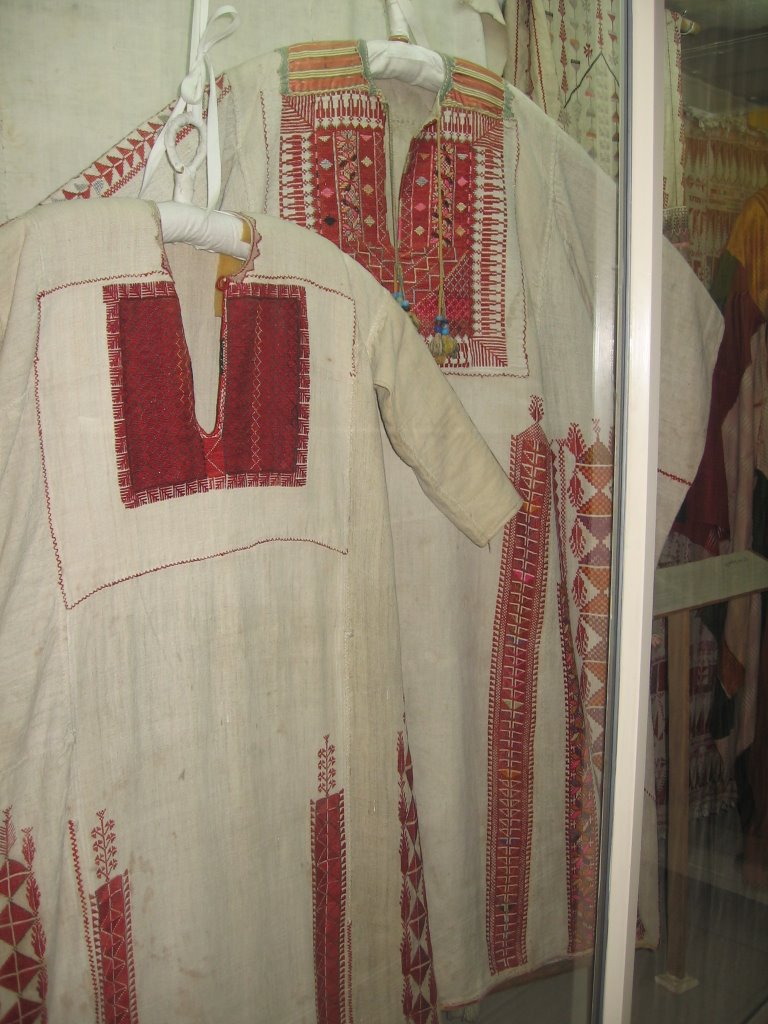
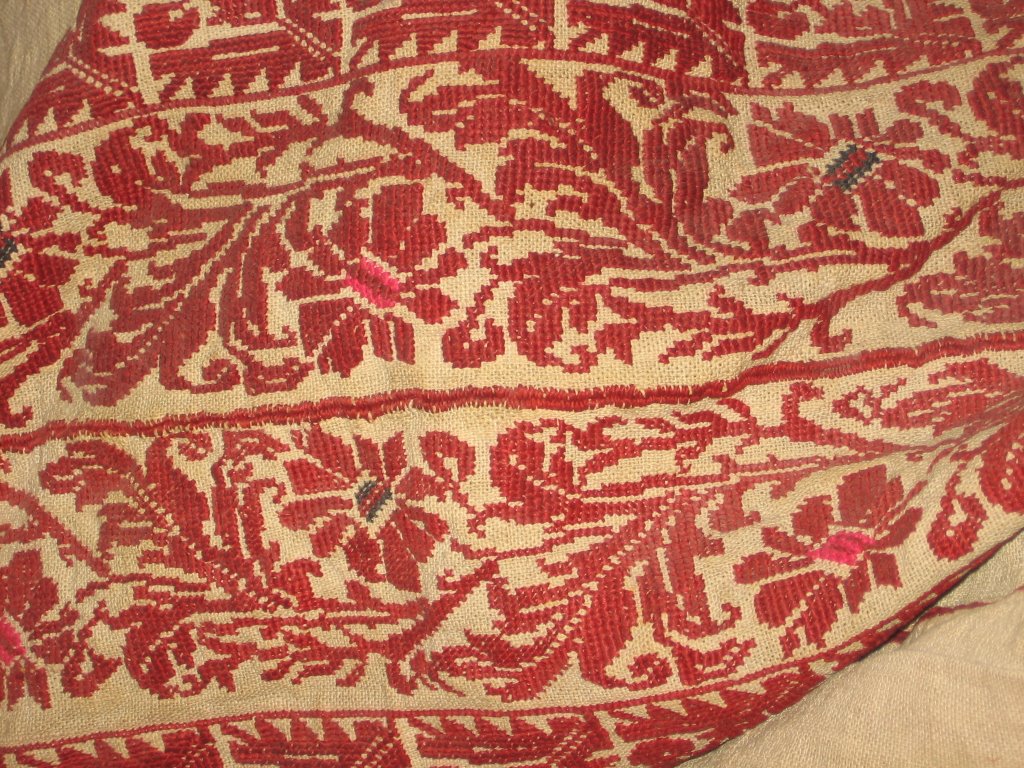
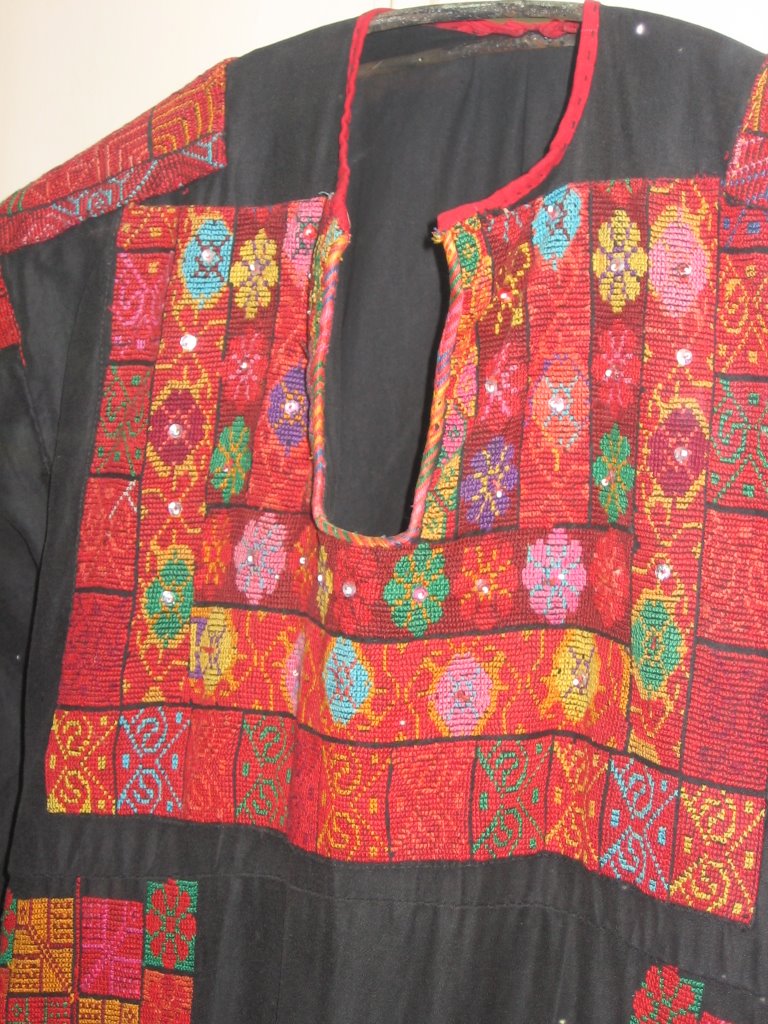
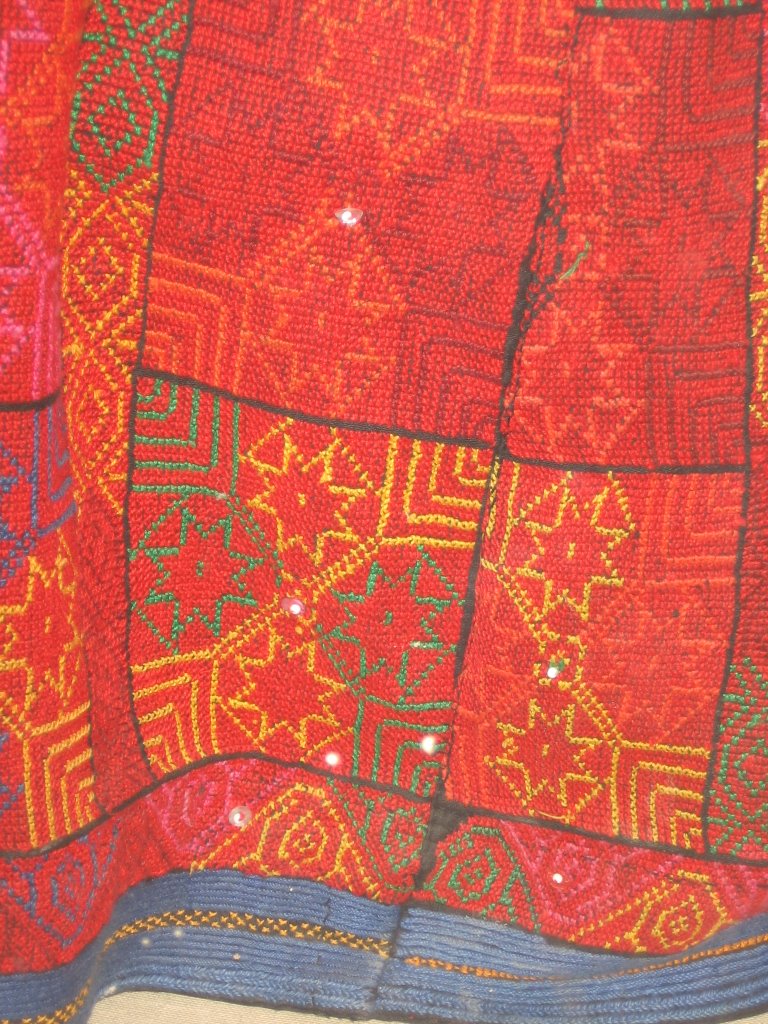
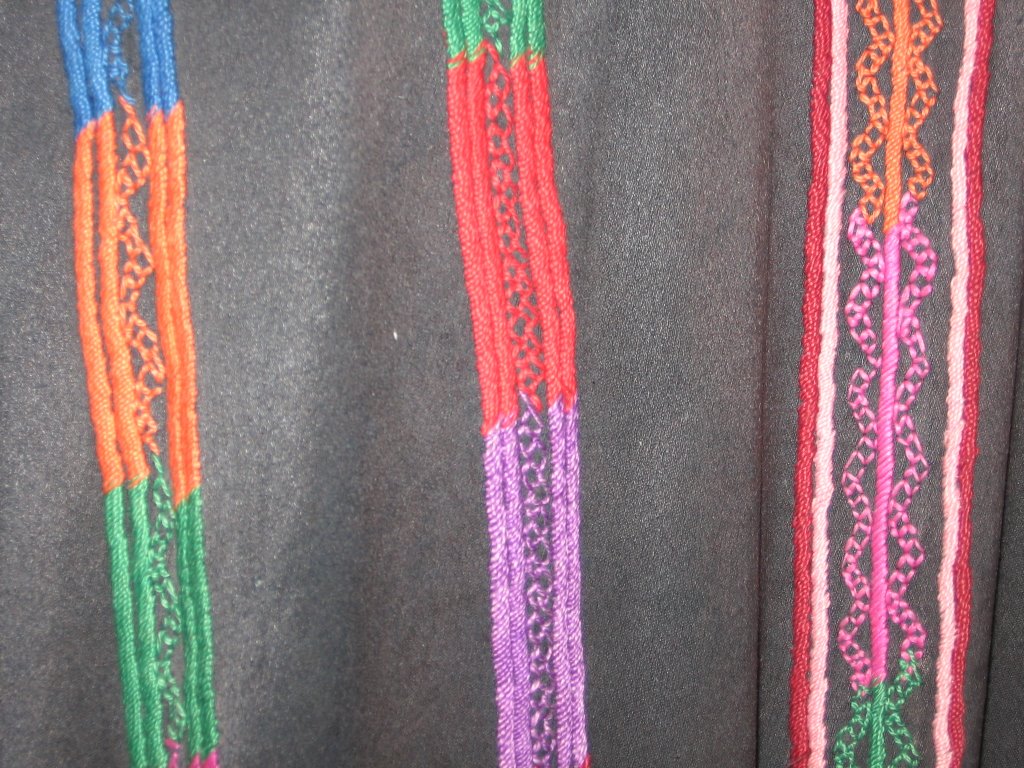
Last one! The close-ups are clear enough to copy or adapt, and if you feel inspired but are no good without graph paper, you will really enjoy the Palestinian embroidery site I mentioned earlier. There are borders of checks, teeth, feathers, flowers and vines, and the large-scale border designs of birds and flowers similar to the one on in the other Ramallah entry.
 The trellis centre left is 'eastern one'. Then come two symmetrical rows of 'saw', and then 'stick' (There are also wider stick borders.)
I like the combination of chequered triangles and variations on cypress tree.
The multicolour star is 'millwheel' with a toothed border.
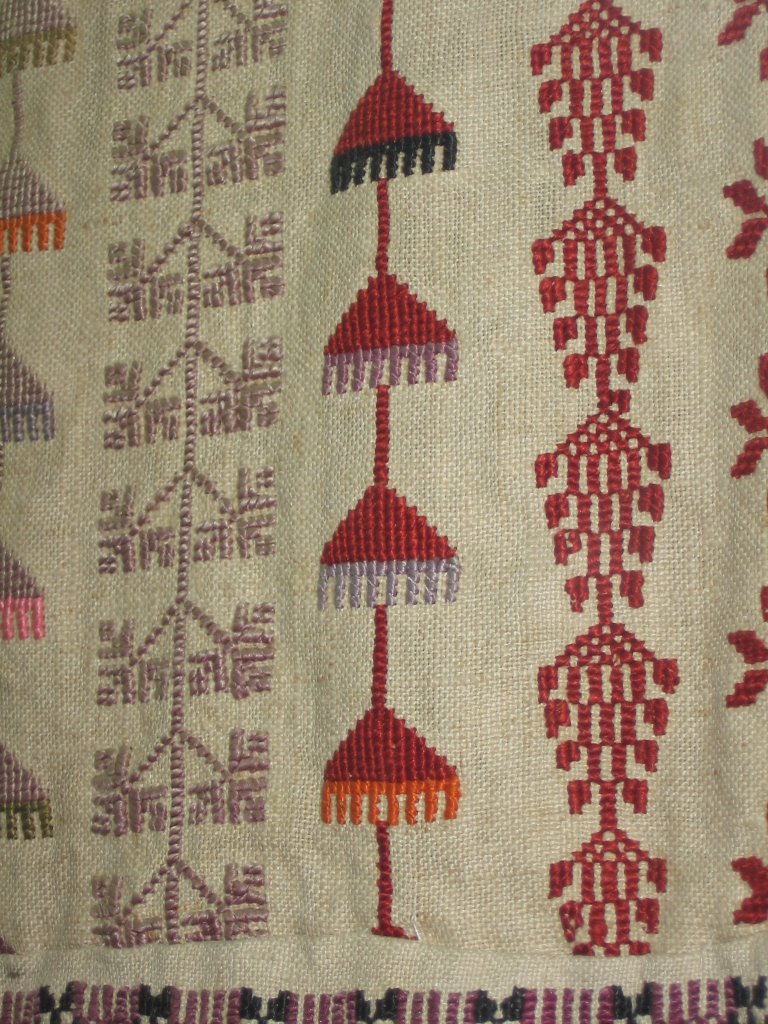 This last photo is a close-up of the ghudfeh you can see hanging (upside down, I think) on the far right of the first pic.
A ghudfeh is a rectangular head-shawl made of three narrow woven strips sewn together.
Here is saru again, and this enchanting silver grey flower border with each flower head similar to riish. I don't know what they call the other motif, but as long as it's upside down, I'm calling it 'lampshade'.
The reason I took so many photos in Amman's fascinating National Folklore Museum is that I haven't seen any books on Palestinian costume here, although there are plenty of thobs and shawls to choose from, as well as lusciously embroidered Kashmiri jackets, coats and pashminas. Ooh! I bought Jehan Rajab's book at the Museum, and Shelagh Weir's has been republished - look out for them for the cultural background and stories as well as the pics.
I'm putting these pics up partly because they are too beautiful to be hidden away, and partly as a record of a part of Palestinian culture, something precious that is overlooked nowadays. It is under extreme pressure, and no doubt much has been irrevocably lost, except among the diaspora.
Ramallah
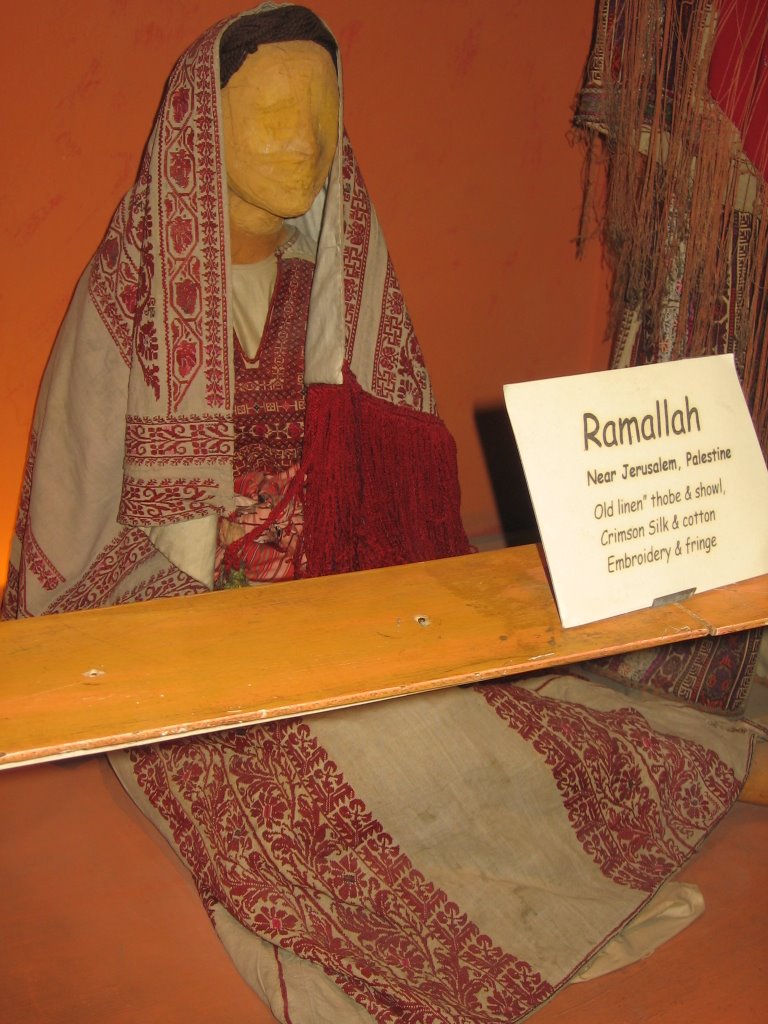
Another favourite - OK, so we know I love colour, skill, and the assumption that beauty is as essential to human life as food, shelter, clothes and friendship.

Beer Sheba 2

Back with the Jordanian bedu. Isn't this fab? (Sorry about the flash, but it was behind glass and I couldn't get the right angle.)
Unlike villagers from anywhere else in Palestine, the bedu favoured long bat-wing sleeves whose points almost reached the ground. The tips could be tied behind your back to get your sleeves out of the way for practical work, or flipped up over your head for shade. JR says that the colour yellow was often used as protection against the evil eye, as well as for its cheerfulness.
No Idea 3 (Dubedubedu)
 I think these are both Bedu, but does anyone know for sure?
I thought at first that the garment on the left was a tunic, worn over a thob with two rich blue borders, but but it's a thob'ob - and so is the one on the right! Colour!
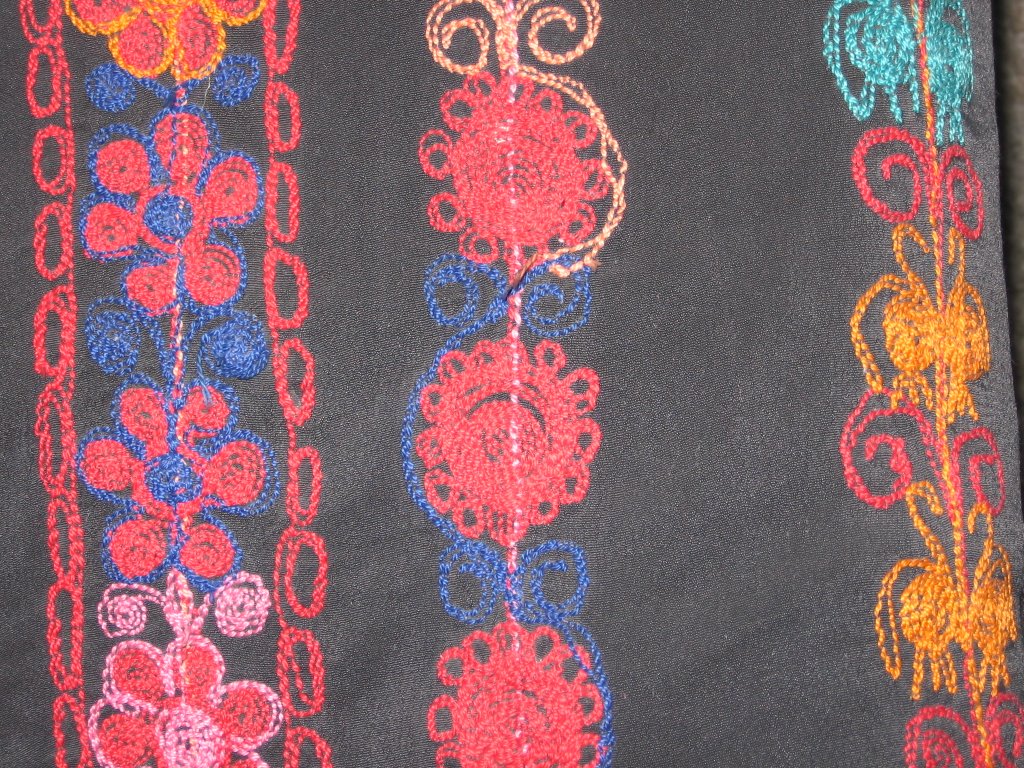
The coloured florets look to me like either couched or machine stitched embroidery yarn.
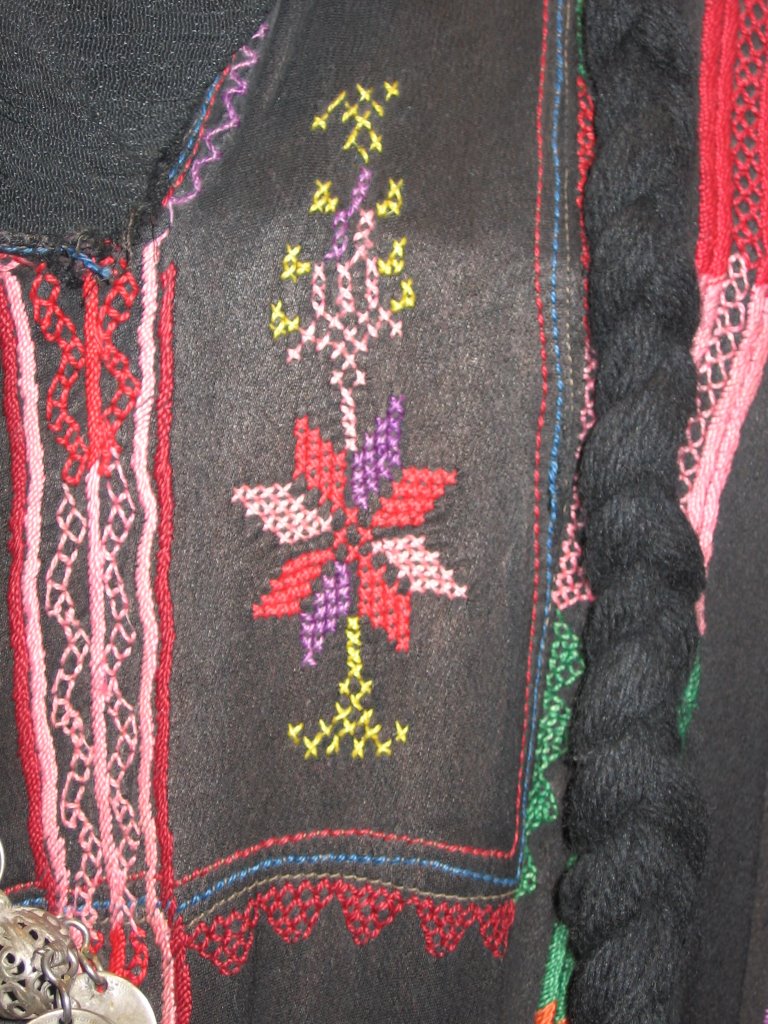
Eight point star and cypress tree
Wednesday, April 12, 2006
No Idea 2 (Dubedu)
 AK has a photo of a Bedu thob'ob from the Tareq Rajab Museum in Kuwait, in similar colours to the thob on the left - but about 3m long! I don't have anything on the blue thob, but I love those tassels (Urgh - flies - urgh. Tassels are functional as well as fun.)
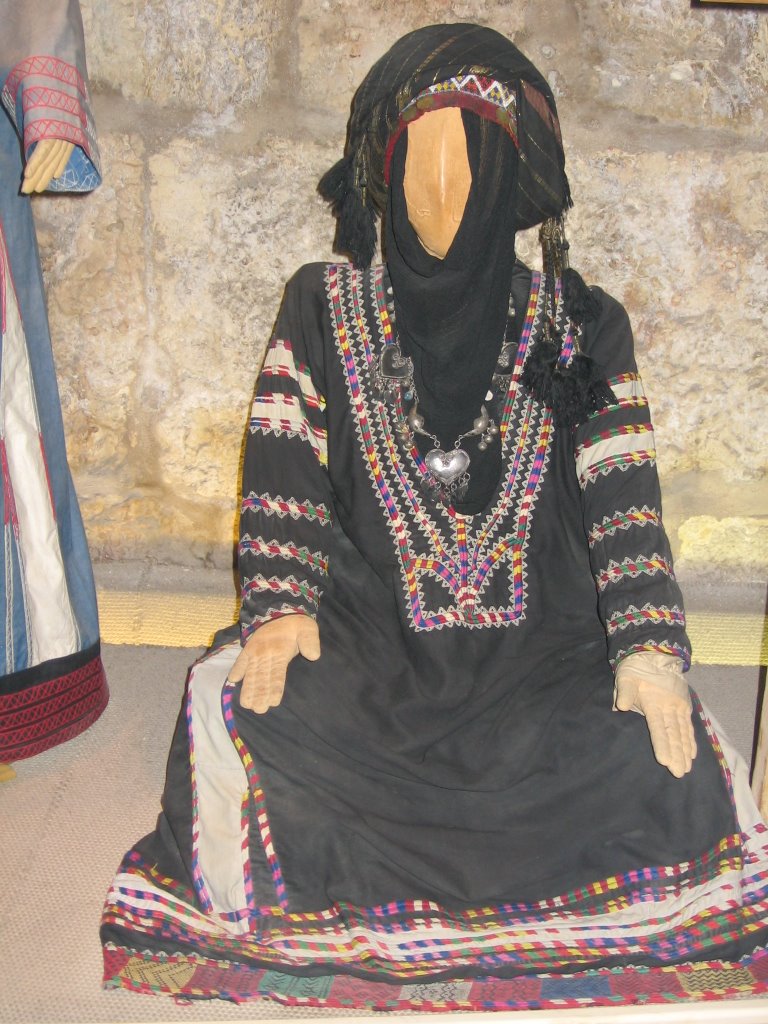 AK identifies something very similar to this (black with white panels and this style of embroidery) as perhaps coming from the Harb of the Hijaz, one of the mountain ranges on the KSA side of the Red Sea coast
No Idea! (Bedu)

When I uploaded all these sets of pics (by region so that I can find them again!), I called this entry No Idea!, and followed it with No Idea 2 & 3, because I can't read the cards in the photos from the Folklore Museum in Amman, they don't look like anything else I've seen, and for once Rehan Rajab can't help. But I pulled out Alan Keohane's excellent Bedouin, Nomads of the Desert (Kyle Cathie publ.) to double check that the rugs in the Beer Sheba entry were bedu - and found all these frocks!
These two are thob'obs, effectively double-length dresses, which no-one really wears anymore. (JR has a lovely 1931 photo (pl. 18) of a bedu woman in a thob'ob.) Perhaps they trapped air and helped keep you cool - Summer temperatures here can reach 50°C, with humidity so high that for months the walk from building to car is enough to soak your shirt to your back: even if the Negev and Sinai deserts have dry heat, like Saudi, it's still like in an oven!
 In actual fact, nomadic life is governed by the seasons and the needs of livestock - primarily the availability of water. Modern national boundaries do not sit well with ancient travelling routes and pastures which spread from Syria in the north, via Lebanon, Jordan, Egypt, across the length and breadth of KSA and the Arabian Peninsula to Kuwait, Oman and Yemen. Alan Keohane lived and travelled with bedu tribes in Oman and Saudi Arabia. We saw black goat hair tents on the southern plains of the Dead Sea, in Wadi Rum, halfway down mountainsides, and up towards Madaba in the land between the ancient Kings Road and the new Desert Highway.
I don't think I've even seen one in the UAE, but I'll save the issue of stateless people and/or 'bedouin' for another day.
Because, dear reader (too many 19th Century novels....) this is supposed to be about the frocks!
Beer Sheba
 This is a bedu style thob. The ghudfeh (head shawl) frames the face in amulets.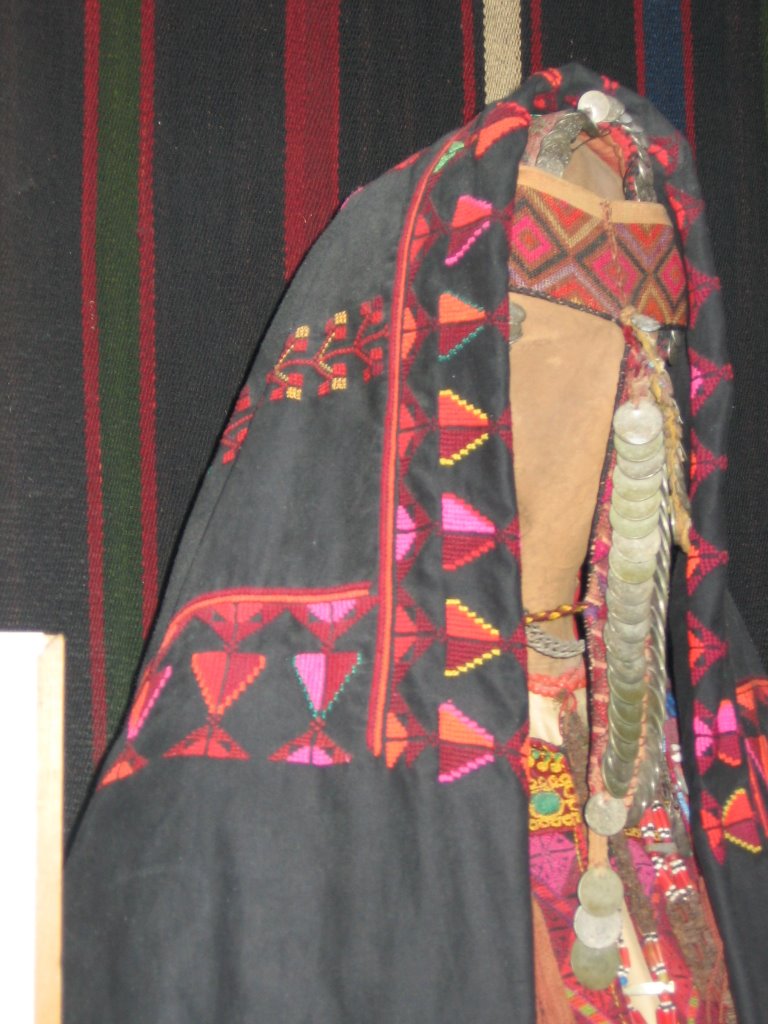
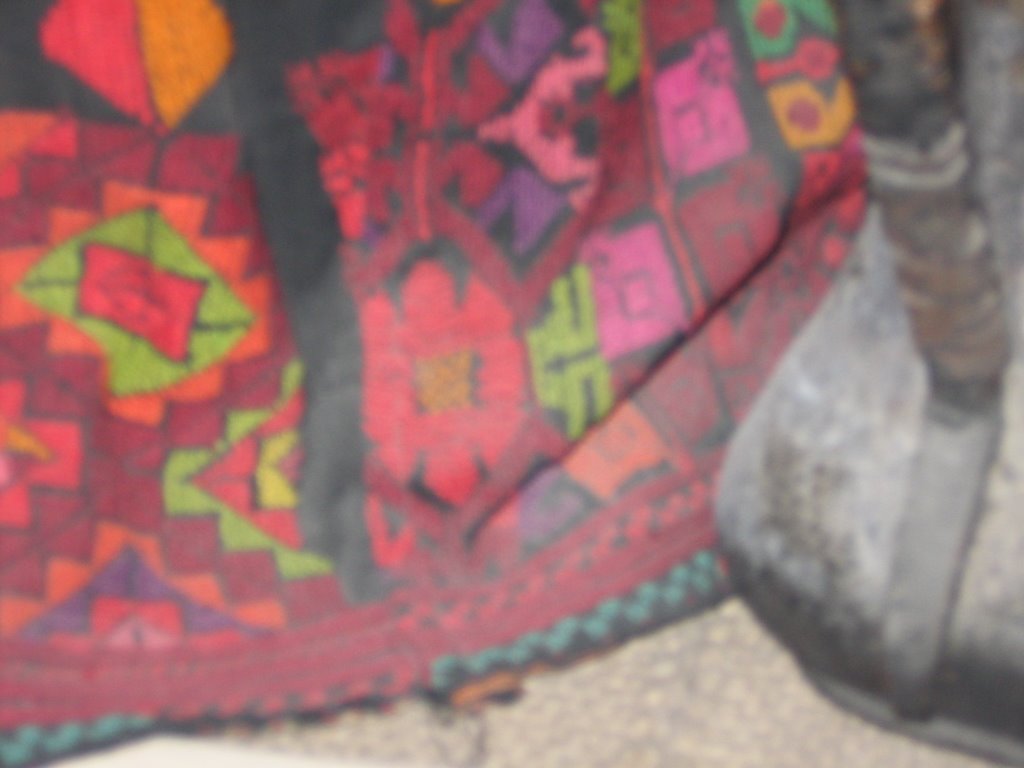 I know that this is seriously out of focus, but this bedu colour palette is quite different from the clear primaries of the other thobs here. Ssee how it blends with the woven rugs hanging in the background. Beer Sheba is in what was southern Palestine, where Jehan Rajab explains the Negeb and Sinai deserts were home to many bedu (bedouin).
The bedu weave wool, goat hair, camel hair and cotton. In the past they dyed their fibres with natural dyes derived from the likes of madder root (orangey reddish) and pomegranate bark (black) .
Nablus

I love the simple elegance of this plain silk qabbeh with its solitary cypress tree framed in feather (saru & riish).
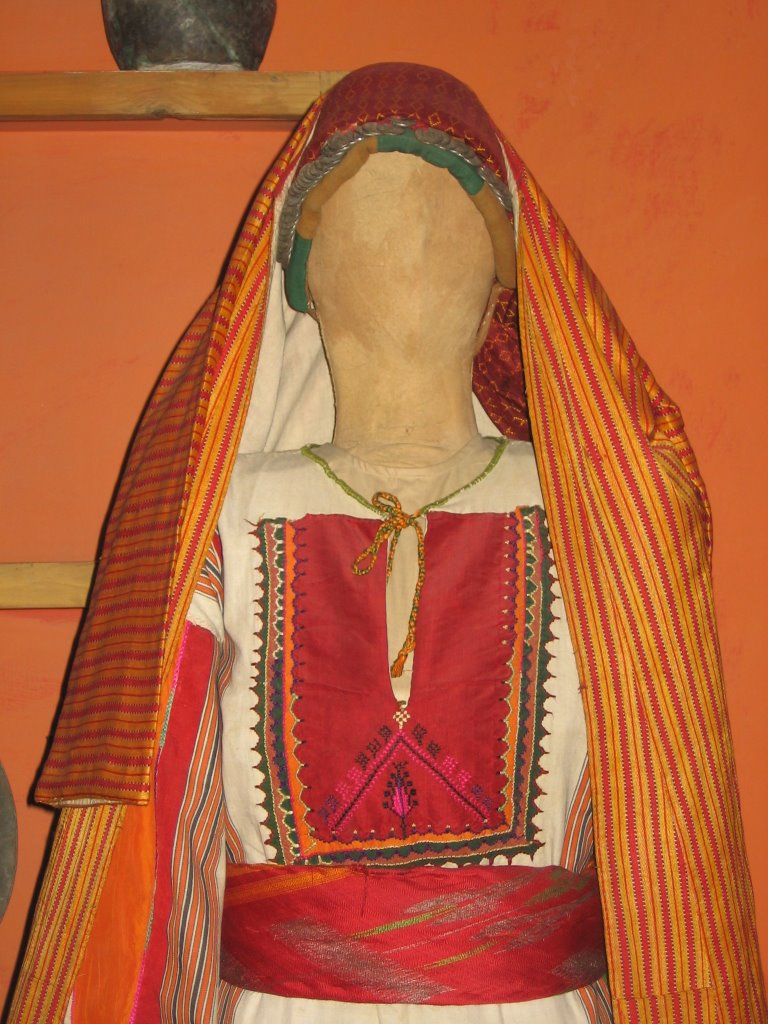
Jerusalem

OK, if you’ve been reading the other bits, you can impress yourself by recognising a Syrian silk thob with Bethlehem embroidery on qabbeh and sleeves, and a very prettily embroidered table cloth – er – shawl. Yay!
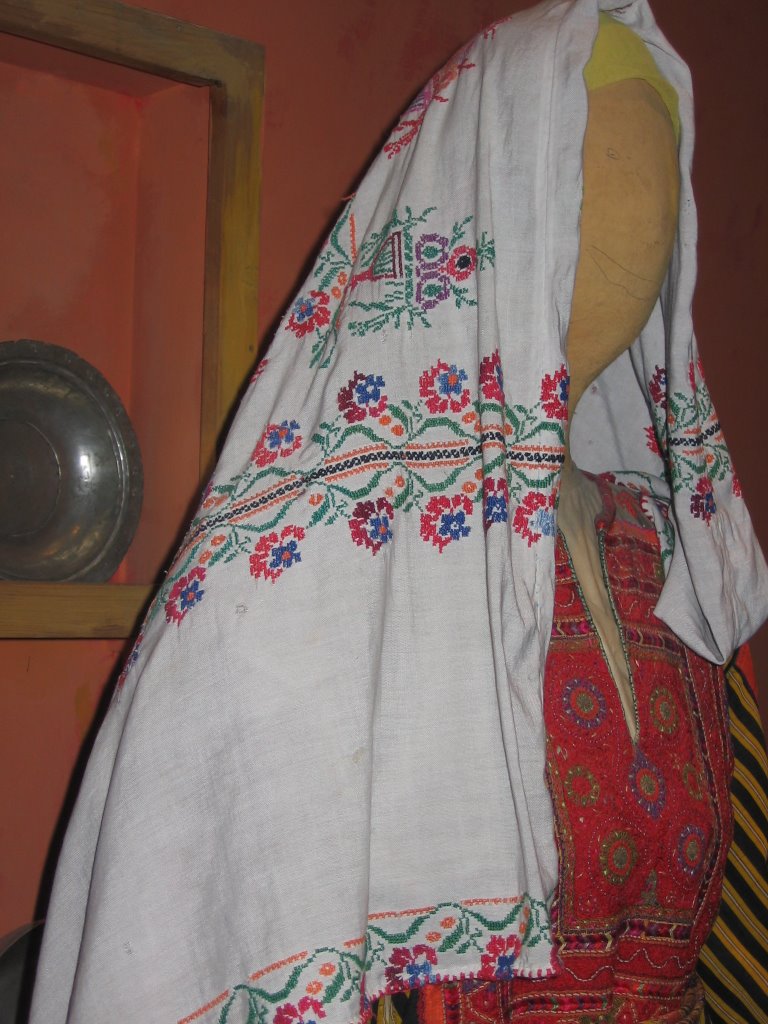
Bethlehem

As you see, Bethlehem's traditions were quite different from everyone else's. For a start, embroidery was a profession, not a domestic skill, and the Bethlehem embroiderers were known for their unique decorative style, which involved couched outlines, often with silver and gold threads, filled in with satin stitch. (In case you don't know, couching is a surface embroidery technique: instead of using backstitch or chain stitch to outline patterns, one thread is laid on the fabric, and then stitched down with another, finer, thread to create long, unbroken lines.) The women of Bethlehem also favoured brightly striped Syrian silk, as well as locally woven cotton.
 This qabbeh (chest panel) reminds me of Persian flower garden rugs, and Elizabethan knot gardens, with groups of herbs and flowers framed by low hedges and gravel paths.
Worked on velvet, it is typical of the Bethlehem style.
Notice also the scarlet velvet taqsireh (wedding jacket). I believe that wearing a jacket was also unique to Bethlehem. Men and women had fairly plain ones for everyday wear, but wedding jackets were sumptuous, as you can see. The jacket sleeves are mid-length, to accommodate the long wide sleeves of the thob, which probably has embroidered silk panels along the shoulders.
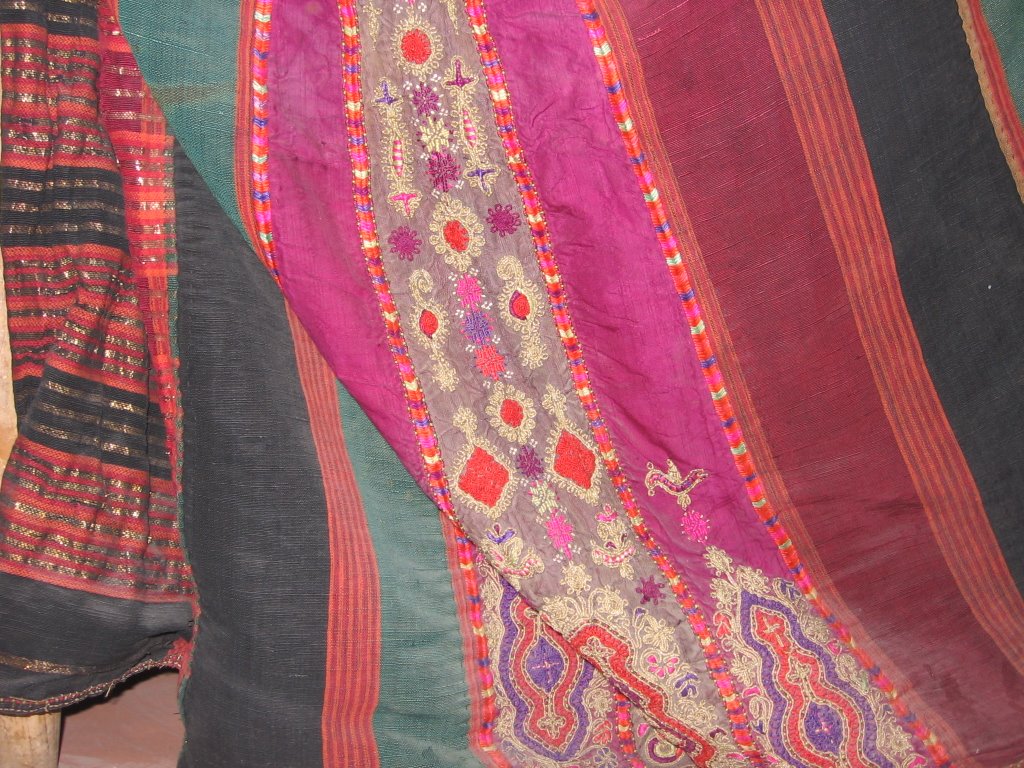
Note the rich and delicate embroidery on the striped silk skirt - see the tiny bird? - all worked without a pattern.
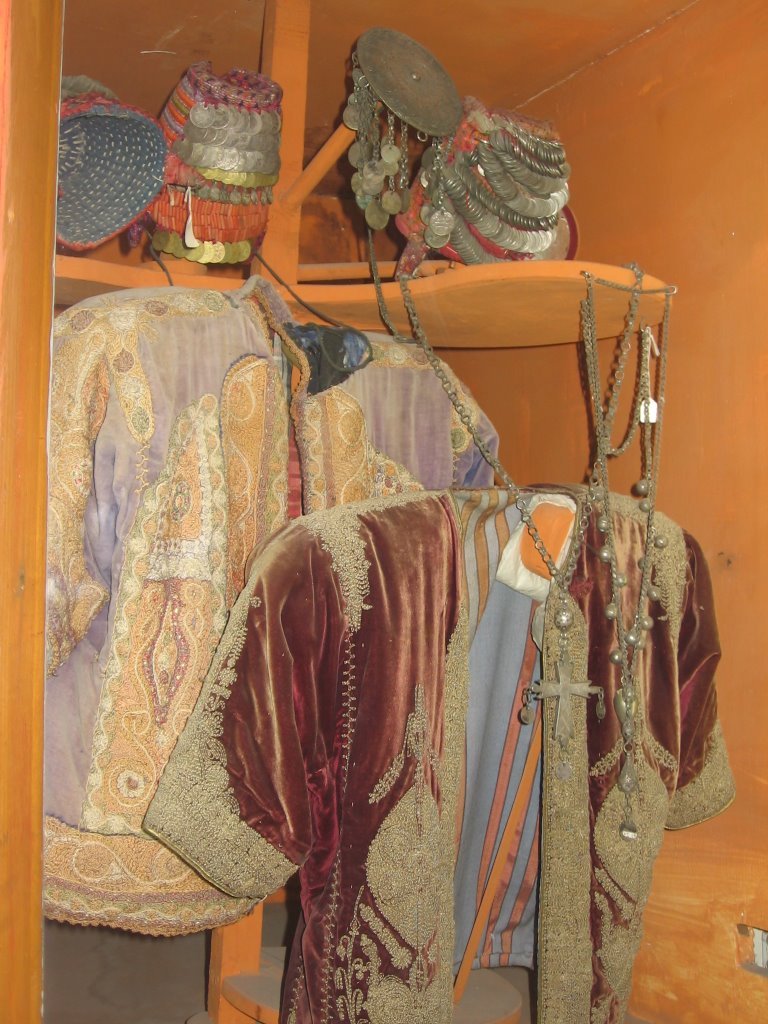 Try and imagine these much-faded taqsirehs in their original purple and scarlet. I dry clothes indoors most of the year, because the sun here absolutely destroys fabric - favourite shirts fade and turn crispy in an afternoon unless you have a canopy overhead.
Notice too the tall hats decorated with rows and rows of coins: these were for everyday too, not just special occasions. Jehan Rajab comments that Bethlehem women did not carry groceries on their heads as women from other areas did!
Nowadays I don't think twice when I see older local ladies carrying packages this way (The younger ones prefer branded designer carrier bags and someone to carry them out to the shiny wheels..... It's true!) - or paper grocery sacks in American films - but both seemed strange at first, because in England we had carrier bags! But, it makes perfect sense to carry the day's fresh vegetables in a wide woven basket (sunshade?!) on your head; and there's no need for handles for a car-culture weekly/monthly shopping expedition, but carrier bags with handles are a must for shopping two or three times a week at the local shops. What's your local style?
Hebron jillayeh

This is called a jillayeh because of the applique on the skirt. Thobs are embellished with embroidery, and jillayehs with applique.

I love these colours! The border of concentric right-angles is called riish (feathers), a very popular border which I've seen with up to seven tiers. The red and cream shield shape is a variation on saru or cypress tree, and here you can see half of a triangle, the amulet motif. ( Isn't this exciting?!)
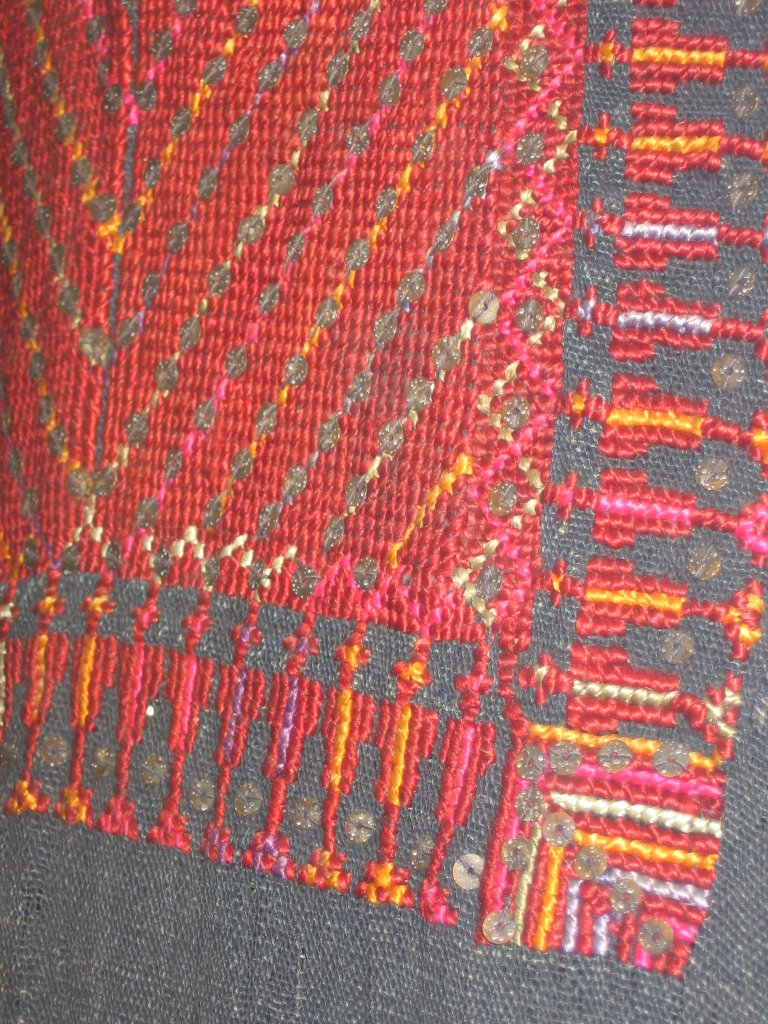
Detail of the qabbeh, or chest piece. Notice the delicate sequins. Again, the colours are wonderful, and as you see, this is blue, indigo-dyed cotton, not black. Imagine doing counted thread work on indigo or black (I've tried, and it isn't funny.) Mind you, living in the middle east, natural daylight brings out the weave and makes the coloured threads sing. There is no comparison with electric light, though shade and a.c. (air conditioning) make up for a lot!
Hebron thob and shambar
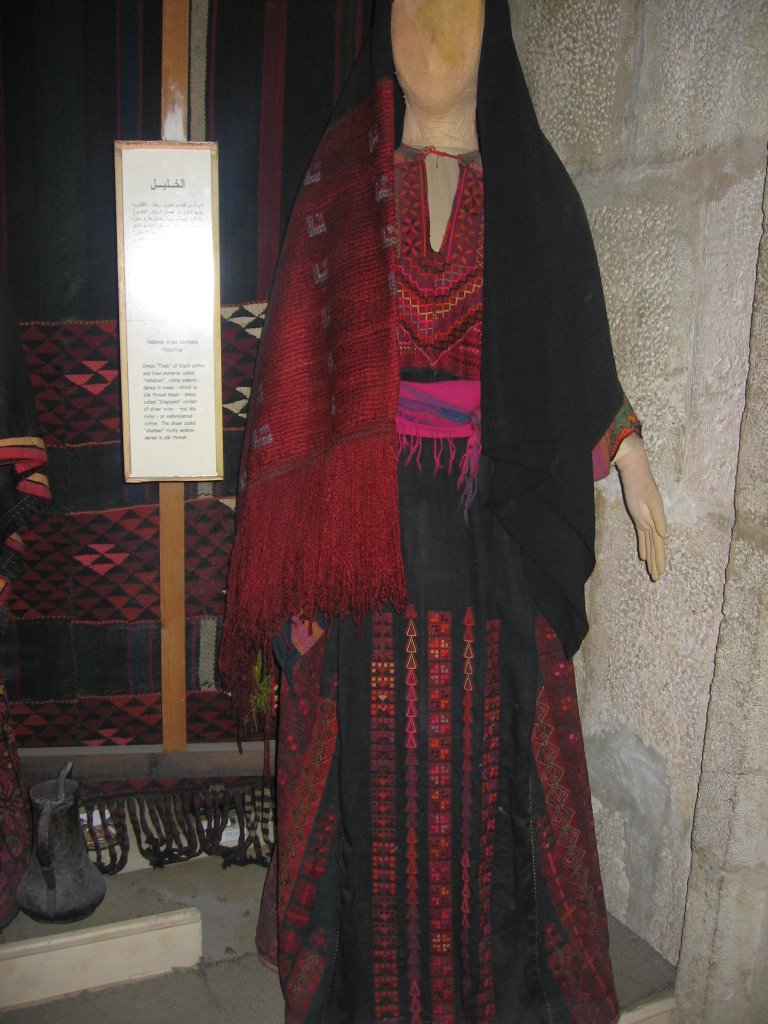
I'm starting with a collection of photos I took of thobs at the National Folklore Museum in Amman. A thob is simply a woman's outer dress, and although all those you see here are museum pieces, they are not necessarily out-of-date. I saw quite a few Jordanian and Palestinian ladies out shopping for groceries in their thobs, and many Palestinian women still sew to maintain their heritage, and from economic necessity. In Madaba we met a shopkeeper who sells the hand- and machine-work of several Palestinian women based in Madaba itself, and Amman, who support their families this way.
The heavily embroidered and fringed shawl you see here is a wedding veil specific to Hebron, called a shambar. I hope the lustre comes through on your screen.
When our school celebrates International Day, everyone comes in national dress, and since we have over 80 nationalities among our staff and students, the atmosphere is always happy, with everyone admiring everyone else's beautiful clothes, or patriotic colour scheme, or inventive draping of their nation's flag! The Palestinian and Jordanian ladies wear beautiful thobs: one of my favourites this year was of natural linen waist-deep in fine burgundy stitching; another was natural cotton with candy-coloured stitching; and then lots of girls came in the familiar black with red embroidery highlighted with traces of green or white. Gorgeous! One thing that I notice about our girl students, who can choose to wear long skirts, is that they all know how to move gracefully in a full-length skirt, (and sprint!) even in clumpy fashion shoes, on stairs, and weighed down with backpacks full of books!
 This photo is a bit over-exposed (and the next one is a bit blurry - sorry) but you can appreciate the richness of this thob, and the skill and exuberant colour sense of the embroiderers. Girls used to learn early, in order to be able to sew their trousseaux. It was part of the betrothal tradition in many villages for the groom's family to make a special trip to buy cloth for wedding clothes, which the bride would then embroider. It would be an advantage to be a skilled needlewoman if you didn't want a long engagement!
Women celebrated daily life and the world around them in their embroidery motifs - as artists do in every medium and culture. There are lots of variations on the moon (qamr) - most of which look like stars (nejm) or flowers to me! The motif repeated down the central column here is nejm el riish, star of feathers, or quatrefoil, The reversed S on the side panels is 'Aleq, the leech in the rose - romance with bite....
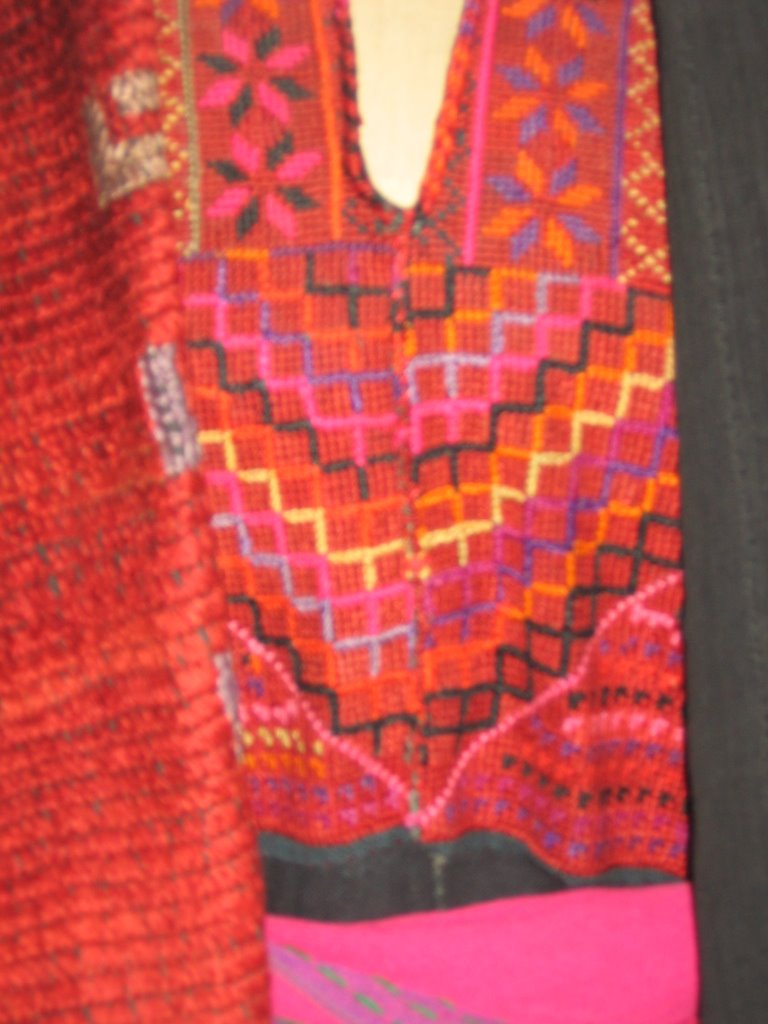 The qabbeh, or chest piece is practical as well as beautiful. The solid embroidery provides extra insulation against cold air, while certain motifs, such as amulet, were believed to offer protection (to the heart?) from the evil eye. If you've seen big middle-eastern necklaces (silver bride-wealth - and insurance against hard times) you may have noticed small cylinders or triangular boxes among the Maria-Teresa dollars and coral and turquoise beads : these would contain verses from the Quran, or hadith, sayings of the Prophet (pbuh). The amulets were worn for protection from the evil eye, and symbolically incorporated into embroidery for the same reason. No, there aren't any amulet motifs here, I'm just letting you know!
For charts of Palestinian embroidery motifs and borders, links to other traditions, and more about Palestinian culture, take a look at http://palestinianembroider.tripod.com/ . I'll put it in the sidebar later.
As you have probably gathered, I don't think that clothes have to be designed in Europe, the US or Australia, produced in a Chinese factory, and driven into our consciousness through the efforts of a pan-galactic media house with an advertising budget to rival the combined GNP of Central America to be beautiful, valuable and fun!
I'm on the Ride to Nowhere
Yesterday I did two things I knew I’d regret. Now I’m regretting them. In the morning I went to my first exercise bike class, and last night I stayed up til 4 a.m. reading Ayalguita’s Cloud from start to finish and uploading photos. So here I am, with calf muscles that whimper if I try to get my heels within two inches of the floor, and the dry eyes and fuzzy head of a post-binge addict. I had fun yesterday!
Actually, I didn’t get on with the bike class at all. When Fitness First opened, I checked out all the gear and facilities, did a private Snoopy Spring Dance of delight, and made a mental list of things to do now, in due course, and absolutely uh-uh, never, no way. The weights and the bike room were the only things on the no way list: the weights because I’m only 5’ 2” (1.57m) and broad shouldered, and I want to emerge from my homage to M. Michelin as a trim little eggtimer (Hourglasses are taller.) not a caricature of an 1970s East German shot-putter; and the bike room because it’s dark, definitely not equipped with British Personal Space in mind, and the bikes are bolted to the floor. Now to me, a bike ride is a practical method for getting from A to B and/or a full-on one-woman sensory buzz - energetic yes, sweaty, probably, and sometimes, when you’re cold, wet, tired, and grimly grinding up a gradient that only a sissy would get off and push up, about as much fun as tooth-ache. But otherwise: Wheeeeeeeeeeeeeeeee! (No, I haven’t had a bike in years, and no, I don’t think I have the nerve or immune system to join the eco-warriors snorting diesel fumes in rush-hour traffic the world over.) What a bike ride isn’t, is a frenzied, disco-driven, tight-pack simulation of a Tour de France night stage. Nooooooooo!
So that was that, no problem, til I met someone who loved the bike room, found the darkness comforting in her pre-Olympian form, loved the drive and variety of a typical session and knew a fantastic – gasp - cardio-vascular – pant - work-out when she – gasp-pant-gasp – got one.
Well ok – game if not exactly enthusiastic, I gave it a shot.
Short answer: nope. Not for me.
I should have known that as the woman who fell off the cross-trainer when little brother took her to his gym in England, and who fell off the treadmill in her first week at FF (Well of course it’s possible – you never heard of gravity?) that anything involving maintaining a rhythm on a machine, in the dark, with my toes strapped to the pedal, was going to end in tears. Well, almost. The instructor was good (cute, too…) and the woman next to me very kind to a nervous newbie baffled by adjustable handlebars, seat and shaft. For a while there, I was doing it. But then I had to 1) use my brain (in the sweaty, pounding, disco dark) and 2) go with the flow. Er… what?
After half an hour, every instinct was flashing red. Think? Adjust resistance? Stand up? Sit down? At this speed? With my toes in a doodad? Remember, disbelieving reader, to a woman who can fall off a cross-trainer and a treadmill, being thrown by an exercise bike is merely the logical next step. Logic + disco-darkness + doodads = escalating anxiety = EXIT PLAN.
And so, 30 minutes into the class, and with the speakers blasting “It’s time to stop.” (Maybe I’m not the first….) I dismounted, nodded sheepishly at the instructor, and tottered out of there.
The rest of the class kept pounding away for another half-hour, and emerged glowing, just as I do from Body Balance (Pilates-meets-Tai Chi-meets-Yoga) Body Jam (Hip-hop-meets-Jazz-meets-Latin-meets-Oooooh allsorts!) and using the machines. It has to be said that I’m not much good at them either, yet, but I really enjoy them, and I feel so much better on a day-to-day basis - looser, more upright, more co-ordinated - that stronger and trimmer and better balanced has to be out there somewhere. Each to her own!
Anyway, Habibi has got off the Internet and gone for a Brisk Walk, so I’m going to post this, and hobble off for a long bath full of Muscle Soak Radox. Nnnnnnnnnnnnnhhhhhhhhhhh………
And I’m going to take down the Palestinian dress pics I was struggling with last night, and have another go later, because I think I might have got the hang of it now. Confidence – the triumph of optimism over experience. There are some advantages to a flat learning curve.
Actually, I didn’t get on with the bike class at all. When Fitness First opened, I checked out all the gear and facilities, did a private Snoopy Spring Dance of delight, and made a mental list of things to do now, in due course, and absolutely uh-uh, never, no way. The weights and the bike room were the only things on the no way list: the weights because I’m only 5’ 2” (1.57m) and broad shouldered, and I want to emerge from my homage to M. Michelin as a trim little eggtimer (Hourglasses are taller.) not a caricature of an 1970s East German shot-putter; and the bike room because it’s dark, definitely not equipped with British Personal Space in mind, and the bikes are bolted to the floor. Now to me, a bike ride is a practical method for getting from A to B and/or a full-on one-woman sensory buzz - energetic yes, sweaty, probably, and sometimes, when you’re cold, wet, tired, and grimly grinding up a gradient that only a sissy would get off and push up, about as much fun as tooth-ache. But otherwise: Wheeeeeeeeeeeeeeeee! (No, I haven’t had a bike in years, and no, I don’t think I have the nerve or immune system to join the eco-warriors snorting diesel fumes in rush-hour traffic the world over.) What a bike ride isn’t, is a frenzied, disco-driven, tight-pack simulation of a Tour de France night stage. Nooooooooo!
So that was that, no problem, til I met someone who loved the bike room, found the darkness comforting in her pre-Olympian form, loved the drive and variety of a typical session and knew a fantastic – gasp - cardio-vascular – pant - work-out when she – gasp-pant-gasp – got one.
Well ok – game if not exactly enthusiastic, I gave it a shot.
Short answer: nope. Not for me.
I should have known that as the woman who fell off the cross-trainer when little brother took her to his gym in England, and who fell off the treadmill in her first week at FF (Well of course it’s possible – you never heard of gravity?) that anything involving maintaining a rhythm on a machine, in the dark, with my toes strapped to the pedal, was going to end in tears. Well, almost. The instructor was good (cute, too…) and the woman next to me very kind to a nervous newbie baffled by adjustable handlebars, seat and shaft. For a while there, I was doing it. But then I had to 1) use my brain (in the sweaty, pounding, disco dark) and 2) go with the flow. Er… what?
After half an hour, every instinct was flashing red. Think? Adjust resistance? Stand up? Sit down? At this speed? With my toes in a doodad? Remember, disbelieving reader, to a woman who can fall off a cross-trainer and a treadmill, being thrown by an exercise bike is merely the logical next step. Logic + disco-darkness + doodads = escalating anxiety = EXIT PLAN.
And so, 30 minutes into the class, and with the speakers blasting “It’s time to stop.” (Maybe I’m not the first….) I dismounted, nodded sheepishly at the instructor, and tottered out of there.
The rest of the class kept pounding away for another half-hour, and emerged glowing, just as I do from Body Balance (Pilates-meets-Tai Chi-meets-Yoga) Body Jam (Hip-hop-meets-Jazz-meets-Latin-meets-Oooooh allsorts!) and using the machines. It has to be said that I’m not much good at them either, yet, but I really enjoy them, and I feel so much better on a day-to-day basis - looser, more upright, more co-ordinated - that stronger and trimmer and better balanced has to be out there somewhere. Each to her own!
Anyway, Habibi has got off the Internet and gone for a Brisk Walk, so I’m going to post this, and hobble off for a long bath full of Muscle Soak Radox. Nnnnnnnnnnnnnhhhhhhhhhhh………
And I’m going to take down the Palestinian dress pics I was struggling with last night, and have another go later, because I think I might have got the hang of it now. Confidence – the triumph of optimism over experience. There are some advantages to a flat learning curve.
Nine Day Wander in Jordan - December 2005-January 2006
Last December, Habibi and I flew from Dubai to Amman, and met Habibibaba off a flight from England for a family reunion. Then the three of us piled into a hire car for 9 wonderful days and 1550 km that took us from ancient Jerash in the north to Aqaba in the south, and almost to the border with Saudi Arabia. At the end, we were exhausted but very happy, and already listing all the places we hadn't got to, and all the places and people we wanted to visit again as soon as possible. My family have all had rhapsodic postcards about the people we met, the landscape, the art, the geology, and the reality of places familiar from bible and history books. Our message remains quite simple: go to Jordan. Just as soon as you can!
I took dozens and dozens of photos on our travels, which just goes to prove that those affordable digital cameras really are idiot-proof. So for your delight, (and mine!) I'm going to post some of them in batches, and add some commentary as and when I get round to it. (This looks dangerously like a plan.... :)
I do hope you enjoy them.
I took dozens and dozens of photos on our travels, which just goes to prove that those affordable digital cameras really are idiot-proof. So for your delight, (and mine!) I'm going to post some of them in batches, and add some commentary as and when I get round to it. (This looks dangerously like a plan.... :)
I do hope you enjoy them.

Saturday, April 08, 2006
Habibibabapapa
What do you you call your nearest and dearest when you blog about them? Shouldn't there be a witness protection scheme for the relatives of us sorry individuals who feel compelled to share our all with every Tom, Dipti and Hagrid?
The arabic word for beloved or dearest is habibi. Say it out loud: it's simply a perfect word: light, warm, sensual, breathless, reassuring, resigned, humorous, all the things that love is. Try it on your mum, your two year-old, your Significant Other - see? When I'm right, I'm right.
In my blog, Habibi stands for my beloved husband, and decades (plural since last Wednesday!) of the whole range of the marriage vows: richer, poorer, better, worse, sickness, health, love, cherish, drive, cook, work all hours, fall asleep in cinemas, snore through concerts, sense of humour, tolerance, creativity, discipline, ethics, quiet determination, piercing intelligence, loyalty, aversion to green vegetables, great legs, impressive liquid grain storage facility, wit, Terry Pratchett obsession, friend in need, in touch with his emotions.... - eh?! Oops - sorry - too many fridge magnets.
And Habibibaba - you can work it out. And if you're reading this, O Habibibaba, here's one for you, courtesy of sensitive lyrical Ogden Nash:
First Child..
Be it a girl, or one of the boys,
It is scarlet all over its avoirdupois,
It is red, it is boiled; could the obstetrician
Have possibly been a lobstertrician?
His degrees and credentials were hunk-dory,
But how's for an infantile inventory?
Here's the prodigy, here's the miracle!
Whether its head is oval or spherical,
You rejoice to find it has only one,
Having dreaded a two-headed daughter or son;
Here's the phenomenon all complete,
It's got two hands, it's got two feet,
Only natural, but pleasing, because
For months you have dreamed of flippers or claws.
Furthermore, it is fully equipped:
Fingers and toes with nails are tipped;
It's even got eyes, and a mouth clear cut;
When the mouth comes open, the eyes go shut,
When the eyes go shut the breath is loosed,
And the presence of lungs can be deduced.
Let the rocket flash and the canon thunder,
This child is a marvel, a matchless wonder.
A staggering child, a child astounding,
Dazzling, diaperless, dumbfounding,
Stupendous, miraculous, unsurpassed,
A child to stagger and flabbergast,
Bright as a button, sharp as a thorn,
And the only perfect one ever born.
I rest my valise.
The arabic word for beloved or dearest is habibi. Say it out loud: it's simply a perfect word: light, warm, sensual, breathless, reassuring, resigned, humorous, all the things that love is. Try it on your mum, your two year-old, your Significant Other - see? When I'm right, I'm right.
In my blog, Habibi stands for my beloved husband, and decades (plural since last Wednesday!) of the whole range of the marriage vows: richer, poorer, better, worse, sickness, health, love, cherish, drive, cook, work all hours, fall asleep in cinemas, snore through concerts, sense of humour, tolerance, creativity, discipline, ethics, quiet determination, piercing intelligence, loyalty, aversion to green vegetables, great legs, impressive liquid grain storage facility, wit, Terry Pratchett obsession, friend in need, in touch with his emotions.... - eh?! Oops - sorry - too many fridge magnets.
And Habibibaba - you can work it out. And if you're reading this, O Habibibaba, here's one for you, courtesy of sensitive lyrical Ogden Nash:
First Child..
Be it a girl, or one of the boys,
It is scarlet all over its avoirdupois,
It is red, it is boiled; could the obstetrician
Have possibly been a lobstertrician?
His degrees and credentials were hunk-dory,
But how's for an infantile inventory?
Here's the prodigy, here's the miracle!
Whether its head is oval or spherical,
You rejoice to find it has only one,
Having dreaded a two-headed daughter or son;
Here's the phenomenon all complete,
It's got two hands, it's got two feet,
Only natural, but pleasing, because
For months you have dreamed of flippers or claws.
Furthermore, it is fully equipped:
Fingers and toes with nails are tipped;
It's even got eyes, and a mouth clear cut;
When the mouth comes open, the eyes go shut,
When the eyes go shut the breath is loosed,
And the presence of lungs can be deduced.
Let the rocket flash and the canon thunder,
This child is a marvel, a matchless wonder.
A staggering child, a child astounding,
Dazzling, diaperless, dumbfounding,
Stupendous, miraculous, unsurpassed,
A child to stagger and flabbergast,
Bright as a button, sharp as a thorn,
And the only perfect one ever born.
I rest my valise.
I like
I like books;
I like 3D objects that have a smell, weight, a taste, a character;
I like texture and colour;
I like boxes and cupboards; and stories about people who live in houses with stairwalls covered in pictures, attics full of family junk, and sheds full of - well - potential!
I like builders' merchants, hardware stores, garden centres and haberdashers, delicatessans, greengrocers, secondhand book shops, junk shops, pet shops, florists, carpet shops.
I like brick and stone and clay and bark and cotton and wool and leather and terracotta and glazed porcelain.
I like the smells of creosote and apples and ink and basil and geraniums and garlic and juniper and wine and bread and soil and eucalyptus and jasmine and roses and chrysanthemums.
I like to walk by the sea;
and rivers, streams and ponds edged with bullrushes, irises and yellow flag lilies;
in woods with leafmould, acorns and beechnuts under foot;
down scruffy paths between lovingly tended allotments planted with fruit bushes, trellises of peas and beans, orderly rows of onions, potatoes and lettuces, and quirky scarecrows improvised from broomhandles, old clothes, car showroom bunting and CDs.
I like to lie in long grass watching beetles beetling and larks rising;
and to sit against a tree trunk and watch the play of light and shadow on the leaves;
or play hide & seek among ferns that curl green overhead.
I like eating blackberries off the bramble and crab apples off the tree.
I like to climb, and just stand, watching and listening to the space of scrubland and moorland as I get my breath back.
I like air that's cool and damp and still, or dry and still, with that silence that a shout or a bleat only amplifies, or cold and crisp, catching your breath in clouds;
and rain that spits, drizzles, spatters, pours, drenches;
and frost on grass stems,
snow on branches,
wind that ruffles and flicks and catches and shoves and tosses and drives and whispers and whimpers and sighs and spooks and roars like a pagan god.
I like haiku, but I'm no good at them.
I like 3D objects that have a smell, weight, a taste, a character;
I like texture and colour;
I like boxes and cupboards; and stories about people who live in houses with stairwalls covered in pictures, attics full of family junk, and sheds full of - well - potential!
I like builders' merchants, hardware stores, garden centres and haberdashers, delicatessans, greengrocers, secondhand book shops, junk shops, pet shops, florists, carpet shops.
I like brick and stone and clay and bark and cotton and wool and leather and terracotta and glazed porcelain.
I like the smells of creosote and apples and ink and basil and geraniums and garlic and juniper and wine and bread and soil and eucalyptus and jasmine and roses and chrysanthemums.
I like to walk by the sea;
and rivers, streams and ponds edged with bullrushes, irises and yellow flag lilies;
in woods with leafmould, acorns and beechnuts under foot;
down scruffy paths between lovingly tended allotments planted with fruit bushes, trellises of peas and beans, orderly rows of onions, potatoes and lettuces, and quirky scarecrows improvised from broomhandles, old clothes, car showroom bunting and CDs.
I like to lie in long grass watching beetles beetling and larks rising;
and to sit against a tree trunk and watch the play of light and shadow on the leaves;
or play hide & seek among ferns that curl green overhead.
I like eating blackberries off the bramble and crab apples off the tree.
I like to climb, and just stand, watching and listening to the space of scrubland and moorland as I get my breath back.
I like air that's cool and damp and still, or dry and still, with that silence that a shout or a bleat only amplifies, or cold and crisp, catching your breath in clouds;
and rain that spits, drizzles, spatters, pours, drenches;
and frost on grass stems,
snow on branches,
wind that ruffles and flicks and catches and shoves and tosses and drives and whispers and whimpers and sighs and spooks and roars like a pagan god.
I like haiku, but I'm no good at them.
Subscribe to:
Posts (Atom)