Showing posts with label history/historia. Show all posts

Thursday, August 11, 2011

Ramadan Kareem

I know it's a bit late, but even so. Both of us thought we heard the call to prayer this evening, and looked round to see the sun three-quarters of the way over the horizon, so perhaps we did. Iftar - time to break fast. But we're out of earshot of the big mosque in Tetuán. We were out of earshot when we lived in Tetuán!

And also, although the first impression was islamic (in the same way that Gregorian chant is specifically Christian, not just European) it developed into something more Spanish, in this case, specifically andalucían.
Al-Andalus was of course the centre of Islam in Spain for centuries, and the West owes an incalculable debt to successive caliphs in Cordoba for the preservation in translation of the heritage of Ancient Greece and Rome.
But Granada, and Toledo were both known for convivencia, basically the ability of Muslims, Jews and Christians to get on with their lives, and follow their faiths, without bothering each other. Until Isabel (la Católica) of Castile set out on la Reconquísta, to reclaim Spain for Christianity under a centralised authority i.e. herself and her husband Fernando (Ferdinand) of Aragon.

Still, you can hear the legacy of that time in flamenco music in Spain, and, in the Jewish world, in Sephardic music - the music of the Spanish Jews, who took it to North Africa, when they also were expelled as part of la Reconquista. The other day, I was introduced to the music of the Israeli jazz musician Avishai Cohen, and the first actual song I heard was this, sung in Ladino, the Spanish-Hebrew dialect of the andalucían Jews in the days of convivencia.
In the comments that follow this YouTube video, I read that some Jewish communities still speak Ladino, and that a Ladino speaker understood just fine when addressed in Spanish. Not bad after five centuries!

Anyway, if there is such a thing as a flamenco hymn of joy to the beauty of a summer evening and the sun setting over the mountains, that's what I think we heard. If I'm right, then somewhere not very far away, on a terrace facing away from Mecca (as it happens) a man was singing his heart out as the sun went down.

I can't make head or tail of most of this song, beyond the fact that the rejected lover has decided to take poison and die - but it sounds pretty cheerful to me, and starts off like someone standing on a balcony as the sun goes down.....

And in the spirit of convivencia, here's Chris August, and some serious sunsets.


Thursday, January 15, 2009

For what it's worth

1
Long, long ago, the Semites lived in the not-yet-Middle-East.

2
And then Abraham begat Isaac; and Isaac begat Jacob; and Jacob begat Judas and his brethren....... Oh, and, by the way, Isaac also begat Esau.

In fact Esau and Jacob were twins, and Esau, as the elder, should have inherited all Dad's (and Grandad's) worldly goods, prestige, divine approval, and some really good footnotes in Genesis, Mathew, etc. - but apparently sold his birthright to his brother for .......... wait for it............ 'a mess of pottage'. (Hence the oft-misquoted adage: The way to a man's hearth is through his stomach.)

The upshot was that the descendants of one bro - Jacob -became the Jewish people (aka God's Chosen People); while the descendants of Esau (All together now, "loooozuurrrrrrrr") became .... the Arabs! Interesting huh? Family Drama B.C.

Anyway, the Arabs were of no further interest to the writers of the Old Testament, while the Jews basked in God's love, which must indeed have been lovely. Unfortunately, it would appear that no-one had explained this to the Romans, who presumably thought that the Promised Land had in fact been promised to them - subjectivity can be such a problem between neighbours.....

3
So the Romans moved in, and waited for the locals to recognise that they were now a conquered people, keep their heads down and their noses clean, pay their taxes, and be good little subjects of Rome. Got that one wrong, didn't you, boys?

(Pop quiz: name one Arab people in the last couple of millennia which has knuckled under to an invader.................. take your time......... there......you see?)

So after a while, the Romans got a little fed up with being constantly dragged away from their banquets and orgies, and never seeing the end of the circuses, all because the bloody locals kept mounting rebellions and holing up in mountain fortresses (where they'd stashed all the best weed too, damn their eyes) and even going so far as to set up some smooth-tongued, appallingly dressed Holly Roller hick from the sticks as their leader - a hippy Peace&LoveMan weirdo who wouldn't know a barber if he bumped into him in downtown Jerusalem on a Thursday night ...... Of course, they sorted him out in the end; with a bit of help from the local Chamber of Commerce (Those guys knew which side their bagel was loxed on.) But the locals were still revolting, so the Romans came up with a Final Solution.
Destroy their Temple and encourage them to LEAVE.
All of them.
Declare their country a non-country.
End of story.

I blame the Romans.

4
And the 'Wandering Jew' became part of European (eh? Where? Sorry, wrong century.) Christendom's world view. Ah, Christendom (i.e. Amost Everywhere.) named after that Peace&LoveMan man that................ the Jews killed. Hmm. Some people have baggage.

Landless people scatter, assimilate, intermarry........blend. Or just die out. Generations later, their artefacts are dug out of burial chambers and displayed in museums for others to marvel at. Scientists do DNA searches. Curious individuals trace their genealogy, and perhaps discover that Abraham XX begat Isaac LV, begat Jacob CIX, begat Mike, begat Brian, begat Jack - and look! Here's the scan of little Jack! Ah!

On the other hand, expats will often cling to the comfort of traditional ways, celebrate the richness of their own songs, recipes, stories, and festivals. They will send their children to expat or international schools - maybe even boarding schools 'back home'. They will make friends among their own community, creating a base of familiarity and mutual recognition - a microcosm of their old world - from which to step out into the wonderful strangeness of their new home from home - and where they can recharge their sense of a shared identity from time to time. Ex-pats often go 'home' once a year if they can afford it - and while they might complain about the travelling, the endless unpacking and repacking, and the long round of visiting and catching up; in the end, this constant maintenance of the lines between old and new lives and relationships also frees many to get more involved in the culture and experiences that their 'foreign' base has to offer. Many will in fact choose to retire and stay 'abroad'. Most, I think, go 'home' in the end, carrying the memories and influences of their experiences with them.

Expats may feel like exiles at times but, unlike exiles, most know that they can go home eventually.
Exiles. Refugees. Diaspora.
Armenians. Jews. Palestinians.
These can never go home. Sometimes, home no longer exists.

The Armenian diaspora - descendants of the refugees of 1915 - outnumber their cousins 'back home', where the Soviet Union expanded into the space left by the Ottomans.

There are Armenian communities, with their own schools and churches, in the Middle East, Europe and the US. These communities nurture a sense of identity and heritage, and continue to act as pressure groups for a review of the events of 1915 - which Hitler would later acknowledge as, if not his inspiration for the Holocaust, at least an example of what a sufficiently powerful invader - conqueror, to use an old term - could get away with under the disapproving noses of other nations - with ruthless will and watertight organisation.

Yet Armenians also marry outside their own communities, even if this may at times resemble the plot - if not the script - of My Big Fat Greek Wedding.... Life goes on. Cultures mix. Sometimes people are happy, and sometimes not. The usual sort of thing. Perhaps two hundred years from now, people will be tracing their family trees back to a plot of land in Yerevan, as Americans now make pilgrimages to small villages in Ireland.

Yet if Armenians have achieved this balance within a century, it begs the question of why - or how - Jewish culture has managed to not merely survive, but flourish, for two thousand years, in a world where Jews have routinely been reviled and persecuted at every change in the political wind. As with Armenians, and more fortunate Palestinians, Jews have contributed to the communities in which they have settled: some of the most celebrated artists, composers, songwriters, actors, directors, writers......... businessmen.......... surgeons............... intellectuals........... stand-up comedians..................(I'm sorry, but I draw the line at Seinfeld) are Jewish. As in identity, not as in amateur genealogist who discovered an ancestor who might have been a night cleaner in the Temple back in 12 A.D.

I come back to the expats. Not military or relief workers, but teachers, oil engineers, insurance and banking personnel. Life is made easier because most foreign postings are on well-trodden routes which have the infrastructure and cosmopolitan character to accommodate expats. And you've got an Embassy, a passport and a contract. You may be concerned, if you're on a longterm, or open-ended contract, that your circumstances may deprive your children of a central plank of their sense of themselves and their place in the world - not to mention alienating them from cousins and grandparents back home. To avoid this, you are perhaps more careful than you would be back home to preserve habits and traditions that will nurture roots, and enable your 'third culture kids' to grow straight and strong in this exotic environment - and cope with seasonal repotting. Still, you're probably in a safe environment, so you settle, and so do the kids.

There are places where you would not be welcome on political, social or religious grounds, but as a rule of thumb, most international companies are cautious about setting up shop in countries where foreign leaders are burnt in effigy twice a week, and there is a grey area regarding the legality of lynching Customer Service personnel in the absence of a money-back guarantee on electrical goods.

5

American Bible Belters and Iranian clerics do an equally good job of stirring up resentment, fear and anger among their own, and proselytising their unfortunate point of view, but if your beliefs make you a target for their rhetoric or invective, there are still plenty of places where you and your way of life will be accepted and respected, if not necessarily understood or shared.

Unfortunately for medieval Jews, the sermons and writings of some very influential Christian clerics in the first five centuries A.D. accused Jews of all manner of appalling vices, and made it clear that the Jewish nation were forever culpable, and to be punished for their torture and murder of Jesus Christ.

I blame the Christians.

There are numerous examples, spread across territory and time, of Jews, Christians and Muslims - the People of the Book (i.e. the Bible) - basically agreeing to differ, and co-existing as peacefully as human beings ever can. Yet, writing or preaching to their own Christian congregations, the Church Fathers warned in the most hideous rhetoric against anything that smacked of participating in, watching or enjoying Jewish traditions.The fact that such extreme rhetoric was deemed necessary in order to discourage fraternisation or judaising suggests that the early Christians were entirely too comfortable with their Jewish neighbours for the Christian priests' peace of mind. This was the language of war - for the hearts and minds of their own congregations.

However, as these sermons were published, circulated and debated over the centuries, they came to be treated as justification for making life as difficult as possible for these Christkillers. As inflammatory labels go, that has to be right up there with The Great Satan.

Hitler's Holocaust was merely the most blatant and concentrated assault on Jews - amongst others. For centuries, in many places, Jews were restricted in what cloth their clothes could be made from (though other members of the population also lived with such restrictions in feudal times) in where they could live, how they could earn their living, what thy could own. They were the bogeymen of bedtime stories. If disease broke out or the land flooded or parched or split apart, then God was displeased that Christians were tolerating Jews in their midst. And that would have to be rectified. However easygoing a community might be, and however much business and trade might be done between the peoples of these different faiths, there was ultimately no security, because if a scapegoat or a distraction was needed, then the Jews were it. Round 'em up. Lock 'em up. Burn 'em.

Jewish culture - I would suggest - evolved from being permanent expats on a hardship posting. What doesn't kill you - or every member of your family - makes you strong, encourages self-reliance, co-operation and mutual support. You know who you are. You know what you care about. You know that while you're being harassed from one quarter, you will always be supported from another - by the people who have to deal with all this nonsense too. If you can find a way to make it feels better - music's good, and a sense of humour comes in handy - then so much the better. And if you can learn that it's what you do, not what you have, that matters - and combine that with some self-respect and a serious work ethic - then the world is your oyster, my dear. (And I may well be talking absolute rubbish, but at least I'm trying to work something out!)

Hitler may have pushed the envelope beyond anything previously imagined, but anti-semitism is ingrained in Christian attitudes and practice, and the Christian viewpoint (aggressively defensive) has underpinned the evolution of western philosophy and human society from Russia to the Americas for two thousand years.

However, I'm not bashing Christianity, though it probably appears that way. Human beings are a strange mix of cerebral and physical. At the base of the large upper, more recently evolved part of the human brain lies the hypothalamus, the most ancient and primitive part: anger and fear make this baby light up, and particularly at stages in our life when hormones are washing about, provide the drive that effectively overwhelms the rational higher brain.

Xenophobia - wariness of the unknown - an instinct to protect and justify what is ours - a need to feel justified, secure, part of something; and it's corollary, a need to identify the other (whatever that might be - haircut? religion? cooking smells? colour? generation?) as something to be ignored, converted, rejected, or removed. This is primitive, essential, survival stuff, however we dress it with words. And the words we use to rationalise such feelings and needs can be used to to appeal to those same feelings and needs in others.

Marketing sermons from fifteen hundred years ago are just this little lot in their Christian guise. If it hadn't been Christianity it would have been something else...... oh yes.... let's call it Islam. God may exist, and we may be looking at the same deity from different angles and calling it God, Jehovah, Yahweh or Allah. Or Buddha. Or Ra. But to insist that there is no God/Jehovah/Yahweh/ Allah/Buddha/Ra but God/Jehovah/Yahweh/ Allah/Buddha/Ra, and that if someone disagrees with you, then they are ignorant, wilful, backward, deluded and in need of being saved from themselves - for my money, that's the hypothalamus talking. And when they've got minerals, fossil fuels, aquifers or a virgin market for manufactured goods, then that 'ol hypothalamus is in evil alliance with the upper brain.

I do believe that the League of Nations was pursuing its avowed aim of working to prevent another world war when it decided in 1917 to establish a national home for the Jewish people, all but acknowledging that the Jews had had a very raw deal for a very long time - and it was time everyone made it up to them. I believe - though I'm not sure - that other options had been considered, including a large, unpopulated space in North America. However, we know which patch they chose - a patch of desert with no-one very important on it, who would of course understand that the Jews needed their country back. Colonialist attitudes prevailed.

The UN, which replaced the League of Nations in 1945 after World War II proved how ineffectual it was, seems to have been entirely blind to the needs and rights of the existing Palestinian population - as I say, colonialism, or paternalism perhaps. I don't think that people from highly developed European countries can appreciate what land means to settled people in the Middle East, a place which is still full of community traditions that go back a very long way. Your land is your part of your identity, your link to your grandparents, your gift to your children, the place where you live and are recognised. You don't just relocate. It was only after World War II, when Britain started clearing slums to build streets in the sky that they began to realise that the built environment has other dimensions beside its obvious physical solidity: realised that the physical and emotional connections that run through and between communities are partly shaped by the physical layout of buildings. Architects and townplanners are still working through the implications of this.

In 1947, disregarding the absolute opposition of the Arab League, and in line with best practice at the time (as demonstrated by the British)the UN redrew the map, intending to partition the land into three territories: a Jewish nation, an Arab nation, and a UN buffer zone. The thousands of Arabs who were displaced from land their families had held for generations were not happy. And the rest, of course, is bloodshed.

Israel is a fact. Creating it was an attempt to turn the clock back. Bad move. Trying to do it again? Yeah, that's really going to work.

However, the current map of Israel and Palestine is virtually a negative of the 1946 pre-Partition map (Where have we heard the word partition before? Always good for the locals.)

Israel had to defend itself against its neighbours, but the expansionists, or Zionists of the early years set about driving Palestinians off land that was designated as theirs. Sometimes they worked by stealth, through a blizzard of paperwork and the full weight of bureaucracy, where generations of people had lived in their houses and worked their land, back to a time when - - when - well no, actually there wasn't a formal written contract or bill of sale stating dimensions et. etc. etc., but my great-great-great grandfather bought this land from that family over there - just ask them, they'll tell you - and built this house and.....(Living in Spain, I can say that there are rural properties here that don't have proper boundary maps, but everyone knows that from that ridge there, to this boulder here is ours, and next door's place goes up the hill to that fence......). No papers, or the wrong stamp, or no stamp, or if the paper had your great-uncle's name on it, but he had died childless and given the deed and the place to your father on his deathbed, and your father hadn't got it changed because everyone knew how it was.

Or they built Israeli houses around Palestinian houses, cutting neighbours off.

Or they sent the bulldozers in - to clear out troublemakers. To teach people a lesson. To protect their people from Palestinian harassment and aggression.

Israel has appropriated more and more Palestinian land under the pretext of creating buffer zones to protect its citizens. It's been doing it for half a century. It has allowed the building and occupation of illegal settlements.

Then the Israeli government considers Palestinians unreasonable when they start throwing things? Start arming themselves? Start fighting back? Start thinking it's better to die a martyr and perhaps achieve something than live to be old and broken at 40 like your father?

Better build a fence. Better blockade routes in and out and make it impossible to move raw material or finished goods - impossible for someone to feed his family - impossible for someone to get to hospital when her pregnancy goes badly wrong - impossible to do anything.

Better push them into a life or death struggle, with no right to fight back. Better crowd them into the smallest possible space, so that there's nowhere safe for them to store or fire weapons, and then you can bomb them, and kill hundreds of them, and hold press conferences about these craven cynics who use their own children as shields. Better hit hospitals, UN food stores, schools. Better do it quickly - before January 20th.

And more and more people keep moving to Israel, a place that has been a warzone for decades. You have to wonder why. I expect they'll need houses.

Generations of Palestinians have lived and died in the camps. Other Arab countries won't give them passports, because this would undermine their claim to their land.

Non-Arab countries and international organisations stand in judgement, and when Palestinians elect Hamas to government in free and fair elections, partly in disgust at the bloated self-satisfaction of Yasser Arafat's old guard, and partly because, for years, Hamas has consistently done what no-one else seemed able to do: got food and medicine in to people who would otherwise have starved and died - when that happens, the Free World raises its pale, manicured hands in horror. Those foolish Palestinians, what are they playing at, electing a terrorist organisation? Better cut off their aid. Better let them starve, and succumb to every virus and infection. Better leave another generation of children to grow up physically stunted, uneducated and feral, wide open to the older guys, the heroes, who are doing something to make a difference, who could show them how to make a difference too, if they're brave enough.........
That will teach them.

It doesn't matter how many music programmes and theatre programmes etc. etc. these people manage to come up with to put some hope and colour in their children's lives. It doesn't matter how much parents love their children, or how much teachers can do with almost nothing, and with little or no income. It doesn't even matter how optimistic and enthusiastic the children may be, in the face of all odds. If Israel's intention is to push the Palestinians into a small space and annihilate them once and for all; and the rest of the world is prepared to let Israel do that because those bad Palestinians keep firing rockets into southern Israel, and only elected governments are allowed to fire rockets, because otherwise it's terrorism, and we don't approve of terrorism....................... well, I suppose they'll all be dead in the next 96 hours.

That'll teach 'em.

Everyone has to stop fighting, decide what moral and physical territory they're prepared to give up, and go talk to each other, listen to each other, and make it happen.

Northern Ireland seemed a lost cause to me as I grew up, but they've just about got themselves sorted. It can be done.

What is the point of any more people - Israelis or Palestinians - living in fear and suspicion - and then dying in a moment, and the whole nightmare constantly repeating and growing? I can't see it myself.


Does anyone else suspect a long game plan?


P.S. Quick! Let's wipe 'em out before January 20th......... Over to you, Jon.

Sunday, November 25, 2007

Santa Barbara

This is the church of Santa Barbara, and I love it.


It's on Calle de Barbara de Braganza, just off Recoletos, but these are two different Barbaras.


One was a Portuguese princess, married to Fernando VI of Spain (His street continues from hers, cos he loved her!), and the other was her patron saint.


I'd only ever heard of Catherine of Braganza, Queen Consort to Charles II of England (I just looked that up: I knew the name but had no idea who she was. It turns out that as a Catholic in post-Civil War Protestant England, she could not be named Queen. And Barbara was her great-great-niece.)
After reading her Wikipedia entry, I have to feel for poor Catherine, despatched to England at the age of 24 (Today is her birthday.) to be married off to the new king, and having to cope with the language barrier, deep hostility to her religion, suspicions and accusations about her loyalty, a philandering husband, and several miscarriages. The marriage sealed a political alliance between Portugal and England, and Catherine's 'large dowry brought the port cities of Tangier and Bombay to British control.'

How remarkable that 'her quiet decorum, loyalty and genuine affection for Charles changed the public's perception of her'.

How touching (!) that Charles, though he 'continued to have children by his many mistresses, ....... insisted that she be treated with respect, and sided with her over his mistresses in those cases where he felt she was not receiving the respect she was due.' OK........... One can hardly paint Charles as a bad husband, though. These were the ways of the times, and it was, after all, a marriage of political convenience.

Notably, though, 'Throughout his reign, [Charles] firmly dismissed the idea of divorcing Catherine, even when Parliament exerted pressure on him to beget or declare a Protestant successor'.

Did she ever have any peace? No doubt, Catherine led a privileged and physically comfortable existence, but I'd say she earned it. Imagine.

S0 - Barbara - a much happier life, I would say. Asthmatic. No oil painting. (See oil painting.) But educated, gifted and loved, and free of the political and religious conflicts that dominated her great-great-aunt's existence.

As for Santa Barbara, officially & divinely sanctioned protector against lightning; and patron saint of 'artillery gunners, masons, mathematicians (I am not making this up!), miners, military engineers, stonecutters [and] anyone who works at risk of sudden and violent death: apparently, there are doubts as to whether she actually existed. No..... really? Certainly, her life story reads like the product of a drunken pub conversation between Douglas Adams, Neil Gaiman, Terry Gilliam and Lord Longford after a seminar on The Folk Tale Heritage of Europe and Asia Minor. It must be true.

There are two images of Saint Barbara in the Wikipedia entry. The first is a typical medieval Christian image of a saint (and it's in thePrado!). The second is a Russian icon: and this is no meditation on Christian suffering and patience; check out the determined, rosy cheeked, Christian warrior maiden. She rather resembles her namesake.

OK. Pictures of handsome church against the blue, blue sky. Yes, folks, it's 3°C here in Madrid. The sun is shining, and the air as clear, cold and sparkling as polished crystal.

Miss Havisham awaits.....


I love this angel!

Saturday, July 01, 2006

Entrada 2

Still no bag, but if you tried the hotel link, I expect you didn´t get far either. Recontacted Manchester and hope for best. No dratted salary yet either. Should have landed Thursday. Not penniless, but like things tidy! Grrr.

En route for Alcazaba yesterday, accidentally found Museo Picasso. Have realised that with every teeny calle (cay-ye - my street map is a plano callejero) marked, Centro Historico looks bigger than it is. Stopped for lunch at Laperia deli-bar, but exhausted and grumpy so back to hotel. Much better after snooze.

Back to Museo just after 6. Gorgeous building, very well spaced and lit, and very interesting collection. 85 pieces donated by P´s son & daughter-in-law. Saw my first 'live' Picasso in Barcelona last year, and was totally thrilled with the pottery he did in his 90s. Definite case of world's most famous artist saying ok - done it all - now for some fun! Goats, bulls, fish, men, women, with all the vigour and clarity of a child's work (up til he starts being told to stay inside the lines....sob!) but infused with an artist's skill and a grown man´s knowledge of the long artistic heritage of the mediterranean.

The Malaga collection is mostly paintings and drawings, with a few pots, some lithographs and some lino prints. Very well mounted: no ornate frames, just free hanging within plain wood frames (Ikea!) with non-reflective glass that's only noticeable when you wonder and check. Picasso makes me want to draw. He makes it look so easy, but also so essential - everyone HAS to draw! How can anyone NOT draw! That's how alive his work is. It's as if he's in every drawing, still making it, and you're in there with him, watching him make it, seeing the model, the room. Even his jokes - I get an impression of a wicked individual sometimes - the Grand Old Man of art putting down something silly and mischievous, just to see if we'll dare laugh, or feel compelled to rub our chins, and blether on in deep seriousness about the line, the composition, tidah-tidaah-tidaaaa. It's a JOKE!!!!! Wicked.

Rapid fade-out again. Not wearing a watch this summer, and the long light evenings are confusing after Dubai's sunsets which always make me think of a tennis ball plopping over a net. Two minutes' peachy aftermath and lights out, that's your lot thank you and goodnight!

So, to the cafe, for an iced tea, freshly made. Took glass to table and spotted GARDEN. Oh, the garden. Oh my. It has to be one of the most beautiful, most perfect little treasures in the whole wide world. A courtyard, paved and with four steps down from one level (tables and chairs) to the next, with big ceramic pots of geraniums in rows on each step, and a long narrow rectangle of quietly bubbling water that brought pigeons and sparrows in ones and twos for time out from the business of flocking around tourists. Miniature orange trees in pots. Natural hessian blinds, black wrought iron, plain windows, cream exterior walls bars. Conifers and vines. Bells from the church. Voices from the street. A secret garden of tranquillity.

Restored, I went to the archaeological site excavated below the building. The Phoenicians founded Malaka (uhuh) in the 7th century BC. The more I see and read about the Phoenicians, the more I realise our debt to them. They had a tremendous impact on Asia and Europe, and their influence is all over Jordan and probably Syria and Iraq too. Artists, traders, farmers, chemists. And where does our Roman alphabet come from? Begins with a Ph!

Back for more Picasso, until informed that the Museum would be closing in 15 minutes. Great restraint in the bookshop: postcards only, and no, I won't be sending them! 9 o'clock.

Essay in mediocrity at Cafe Tren: some kind of plastic cheese and oragano toasted on tinned tomato. The bread was crisp on the outside and fluffy on the inside, but did not compensate. However, the chocolate con ron was very sweet, smooth, thick and delicious before bed, though I don't believe the 'ron' bit for a second.

This morning, I took camera and video camera and went out at 8.30 to beat the heat - er yeah, that really worked...... Walked to the port, along Paseo del Parque, and up, up up 1116 metres to Gibralfaro. Met an old man near the top, and had one of those funny conversations you can only have when neither of you speaks much of the other's language, and you know you'll never meet again, but you've taken a shine to each other. We compared our knowledge of each other's language, and of French, and talked in a mix of all three about Malaga and our school experiences and what I'm doing, with lots of sign language and exaggerated facial expressions, and louder and louder voices. It was brilliant, and we were totally delighted with ourselves and each other. Then he went back to his newspaper and the view.

I went back to climbing that darn hill. Surely fortification was unnecessary: any soldier who made it to the top could be felled by the flick of a finger. Gaaaaaah! Tremendous view, though, even on this muggy morning. Didn't actually go into Gibralfaro. Very hot and all outdoors except for a military museum which doesn't interest me. Bought bottle of orange and mandarin juice (yum) and got the bus down. Stopped to photograph a wedding (It was fun!) and then walked to secret entrance to ascensor (LIFT - oh THANK you!) to Alcazaba.

Alcazabar is beautiful. The stonework is handsome, the rooms are surprisingly small (Al cazabar means a fortress palace) but high celinged, white and airy, and the architecture is Islamic. It was a very enjoyable experience to wander through this foreign but familiar place, appreciating the cunning use of space and water that turned a defensive structure on quite a limited footprint into an enchanting labyrinth that drew the eyes and the feet to one courtyard and outdoor corridor after another, all beautifully paved and planted, and designed to catch and divert every breeze. Finished films and batteries! I am so glad I went.

So, that was my morning. I´ve been here in the a/c for a couple of hours, and it´s about time to get out there again. Back to the hotel, fingers crossed for my errant bag, but not really hopeful today. I explained to the manager's father last night.

"Avion de Dubai a Istamboul, dos bolsas. De de Istamboul a Manchester, una bolsa! Questo (indicating clothes) es todo!"
"Solo?"
"Si!"
"Aahhhhhh..."

Actually quite pleased with my Spanish. Very messy but getting by. And I´ve bought a copy of Holá, and have been reading the local free newspapers. Nouns and verbs very similar, though this can be misleading, and I've got enough of the useful little words to make sense of quite a bit. Tiring though, and my lips move!

Saturday, May 27, 2006

Beating (about) the Bush

Underground Dubai linked to this story in the Times Online, entitled Dubai’s building frenzy lays foundation for global power, from The Sunday Times of May 21st. I thought it was a carefully balanced story, which means that only half of it would make it into the local papers here. After I'd put in my tuppence worth on UD's blog, I sort of kept on going with some thoughts that have been building for a long time now, despite my efforts to Accentuate the Positive.

Basically, things are impressive here, but not perfect, and as I've written elsewhere, I'm nervous about the future here - not for myself, because after nearly thirteen years, it's just about time to go - but for Dubai itself. Whenever change occurs, something is gained, and something lost. Dubai's turning into a dazzling showgirl, but it also seems to be rapidly losing its humanity. That's one thing.

Secondly, although I agree with those who shake their heads at the underside of Dubai's development (See the article) this is another case of the distinctions between countries at different stages of development.

Thirdly, I think that the rhetoric coming out of the US - ok, Washington - ok, George Bush - is so counterproductive that I can't believe he gets away with it. So this is my opinion, for what it's worth, and then I'll say goodnight.

REPLY to UD's blog and reading the Sunday Times article:

Thanks for pointing this out. I was just thinking the other day about where this is supposed to be going - given that I along with nearly everyone I know find the construction, avarice, traffic, cynical exploitation of workers, shameless withdrawal of 'gifts' of land from long-established social and sporting societies, extravagant use of water, endless apartment blocks with no community facilities, etc. etc. oppressive and demoralising. And I thought to myself: it’s too ambitious to only be about being a regional hub for IT and commerce, and generating wealth for the national population; it’s got to be about becoming a beacon of Middle East success to the West and our neighbours: dynamic, safe, free of politics, corruption, etc. A sock in the eye for the detractors who stopped the Dubai Ports deal.

So it doesn't really matter what we temporary residents, transients, feel, or even what this generation of Emiratis think of it all, because we're not the target market. What we are experiencing now are growing pains as this emirate sets out to do in twenty years what other countries have taken fifty or a hundred years to achieve. No wonder individuals on the inside are disorientated, and outsiders keep talking about Disneyland. This will be a New Town, prefabricated for the next generation. It will be up to them to give it a heart to replace what's dying here.

AND the rest of it.

Then there will be leisure for a social conscience regarding the inhabitants of the place. All in good time. I don't subscribe to this. And yet, shouldn't we recognise that the First World countries critical of attitudes and practices here, built their wealth in the bad old days of slavery, colonialism and the 'renewable resource' of cheap and plentiful immigrant labour; and that their social, political and judicial structures and national consciences have evolved since then? Industrialised England, New York, the Great Wall of China, the Egyptian pyramids, and the Aztec and Inca cities were all built on the backs, blood and bones of labour deemed disposable according to the values of the time. Times change, and so do attitudes, but as we've already seen with international concerns about fuel emissions, dirty coal, nuclear energy etc. what seems only commonsense to a developed nation, sounds like economic protectionism masquerading as a global conscience to the developing nation pulling itself up through whatever resources it has. Nor does the recent record of First World countries in Third World Countries square with our educated liberal modern consciences. And what's the latest on Baghdad, Guantanamo and the Land of the Free?

Excuse the bitter little diatribe, but man's inhumanity to man, collective short-term memory and infinite capacity for claiming the moral high-ground, not to mention the almost literal reclaiming, by the dubiously elected leader of the secular United States of America, of the Divine Right of Kings, which does impart the flavour of crusade to his country's activities in the Middle East, no matter how well his speech writers try to spin it, is going to get us all killed one of these days.

Turkey, Egypt, Afghanistan, Pakistan and Iran are at least open about the conflict between those who believe in an infallible God whose will should permeate society, and those who don’t, or who at least believe that individuals of conscience should group together to work for a just, compassionate and economically viable society. In the West there has been official separation of Church and State for generations, in some cases, centuries. Most westerners take it as fact that no individual, regime or system is perfect – or not for more than a few years, until circumstances alter cases – but everyone does their best according to their own lights, and we rely on the group - cabinet, parliament, electorate - call it what you will, to rein in the zealots, the corrupt, the megalomaniacs, the tired and disillusioned.

Part of what afflicts the world right now is the gap in understanding between the secular mindset – How can these people reject freedom of thought, speech, will, and mindlessly obey/believe/uphold that oppressive regime? And the religious mindset – How can these people disregard the laws of God, laid down for our benefit, and risk eternal damnation?

In the west, there is general mistrust of the political ambitions of ruling clerics – and not without reason, for do not these religious leaders with secular power have the usual human flaws? Europe took centuries to curb the secular power of the Papacy, and how many corrupt popes, linked by blood to various ruling families, played power games, or lived lives of debauchery before that happened? Didn’t Christianity split into Roman Catholic and Byzantine Orthodox long before the Reformation?

On the other hand, Russia and China both went down the paths of atheism – and the suppression of religious practices, groups and individuals – in pursuit of their ideal secular social model. It still goes on though the times, politics and names appear to have changed somewhat - but they don’t pretend otherwise, simply tell everyone else to mind their own business and leave their countries to them. They are open for business, not external reform, and look who's buying. So we’re all clear on Russia and China.

The one lesson that comes out of this is that ‘The danger is not that a particular class is unfit to to govern. Every class is unfit to govern...Power tends to corrupt, and absolute power corrupts absolutely.’

And this applies to both clerics and secular authorities. It would seem that democracy is the key to social justice and honest government. Being elected for a fixed term, with the guarantee of being booted out for incompetence or corruption, and a maximum tenure no matter how terrific you think you are, checks even the Berlusconis of this world.

Except that the other half of the equation is the electorate, which has a moral responsibility of its own: to think, to weigh the worth of the candidates and the needs of the parish/town/city/region/country; to vote according to informed conscience not out of habit or fear; to vote – not abnegate responsibility for the community; and to be patient and open, allowing representatives time to do their job, and not take up weapons and hit the streets when no magic solution is delivered within months. It’s so easy not to bother. Violent activity is such an easy vent for frustration. Responsibility isn’t as easy, or as invigorating.

So how does it come about that the citizens of what has been – at least until recently – the most powerful nation on earth, managed to elect not once, but twice, a barely competent, vain, arrogant, opinionated, blinkered, self-satisfied, isolationist, xenophobic, religious zealot to be their president? Did I miss anything?

The signs were there the first time around.

Kyoto Treaty? Handy short term domestic gains at expense of betraying international agreements and relationships? OK.

Steel tariffs? Handy short term domestic gains at expense of betraying international agreements and relationships? OK. (Easier second time around).

International War Crimes Tribunal? Nope, not for God-Bless-Americans!

9/11: Didn’t see that coming, better hit someone back. Oops, missed in Afghanistan –

OK let’s

1) whip up hysteria on the back of national grief so that I can do what the Lordy-Lordy I like,

2) deflect attention from failure – What’s happening in Eye-rack these days?

3) find a bogeyman (See 2),

4) whip up a pretext – ooh… well in the movies they always say they’re going to destroy the world……. What about……Weapons of Mass Destruction?…OK!

5) make oil reserves safe for democracy…… um…… make the world safe for democracy. OK!!!


Butbutbutbut what about diplomacy?
What – the talking and listening kind? Nah. Unamerican. And invasion plays better on Fox.
Butbutbutbut what about the peace?
What peace?
After the war……we need a plan, personnel, resources, someone who speaks Arabic.
.................Listen sonny, we’ve got to catch the morning papers and breakfast TV -
Oh......

And despite all the Not In My Name Efforts, off they went.

And despite all that followed, the fine Christian people of America, voted Dubbya in again. In response to what? Gay marriages (Find a bogeyman): the threat to Our Way of Life.

What happened to the separation of Church and State? What to make of George W. Bush’s Divine Smokescreen? God-on-our-side may have provided an unholy election miracle for the Republicans, but look at what it’s doing to the United States' international standing, and everything it touches these days! (Yes I know that there are thousands of Americans involved in relief efforts in some of the toughest places on earth, and many of them face hostility nowadays - I’m talking about this administration’s blinkered home-based electorate and self-righteous foreign policy.)

How can the people of America not see that their foreign policy has destroyed their almost mythic virtue in the eyes of their old allies? Cheat your neighbours. Betray your friends. Make scapegoats of political irritants. Destroy the old and iniquitous with no thought of how to encourage new growth, unless it means contracts for American firms. Make endless allowances for old friends steeped in blood and oppression; sign trade deals with old enemies in the hope that they’ll take you with them on their way up. Human rights abuses? No problem.

It can be argued that international diplomacy is always, ultimately about the bottom line. In fact if it weren’t for the unstoppable determination of traders and merchants to expand markets, most countries and continents would probably be at war most of the time.
Mammon the peacemaker.

To return to the beginning, and the critical stance taken by outside individuals, organisations and governments on the development of Dubai – how else will the world improve if not through the encouragement of best practice in all areas of society? It is good that First World countries wear their consciences on their sleeves, and actively seek to promote freedom and justice everywhere. And here in Dubai, there must surely be room for the personal and property rights of the individual in the brave new world rising out of the sand.

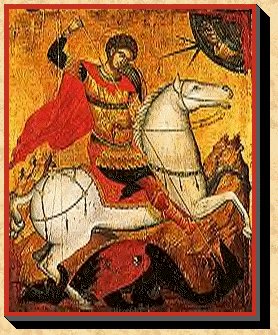
But for the identified leader of the western world (even if that perception is mistaken, and he’s just another bogeyman) to cloak the destabilisation of the Middle East through economic and political aggrandisement in the rhetoric of Christianity is not only disingenuous, but fans extremism in America’s Bible Belt as well as the Islamic world. We all know it’s about securing gasoline for American cars, and oil for American boilers: and the politicians and clerics in the Middle East all know it too. But how helpful of Mr. Bush to give them exactly what they need to inflame the hearts and minds of people already very angry about Israel, Palestine and Iraq. The worrying thing is, no-one really knows for sure whether this is political posturing, or if he really does see himself as Saint George. Either way, we’re in trouble.

If the American people as a whole (with the honourable but ignored exception of a large minority, many of whom live or have lived in the Middle East and elsewhere) are so complacent, so self-righteous and self-absorbed that the private lives of a tiny minority figure more powerfully than the lives of thousands of American service peronnel and thousands upon thousands of Iraqis, the ongoing misery and shame of Israeli state sponsored terrorism against Palestinians, (not just Palestinian terrorism against Israelis) and the USA’s descent, in the eyes of the rest of the world, from historical ally, powerhouse trading partner, and honourable – if flawed – defender of justice and democracy around the world, to duplicitous, racist, self-serving aggressor, ready to jettison constitutional human rights and ignore the sovereign rights of other nations whenever it suits, then I suppose that they have the President they deserve.

George Bush and Mahmoud Ahmedinejad certainly deserve each other, particularly as Dubbya’s foreign policy probably contributed to Ahmedinejad’s rise to power.

But do the rest of us deserve them? At the same time?

Maybe the joke’s on us. God is out there, watching the floorshow with a Deity Pack of Kleenex. Apocalypse Any Minute Now. Not delivered, as previously assumed, by God, but wilfully crafted by his ultimate creation. (No, not the dolphins, you idiot!)

Would someone like to explain the bit about God again?

Goodnight!

Friday, May 12, 2006

1000 years of knowledge rediscovered at Ibn Battuta

No, I'm not on commission, but I do like exhibitions with a clear narrative or theme, with well spaced exhibits I can walk around in my own time, and good background information. I don't expect this in a shopping mall.

Since I can spend hours absorbed in such things, I also like to know that I can go rest feet, mind and spirit over a coffee, before going back for more. Aha! Shopping mall!

Here are a few images of an excellent exhibition of 1000 years of Muslim achievement, at Ibn Battuta Mall. Definitely worth a special trip, especially if you can get down during the week, or on Friday mornings, when it's quieter. Don't even think about Thursday or Friday night....


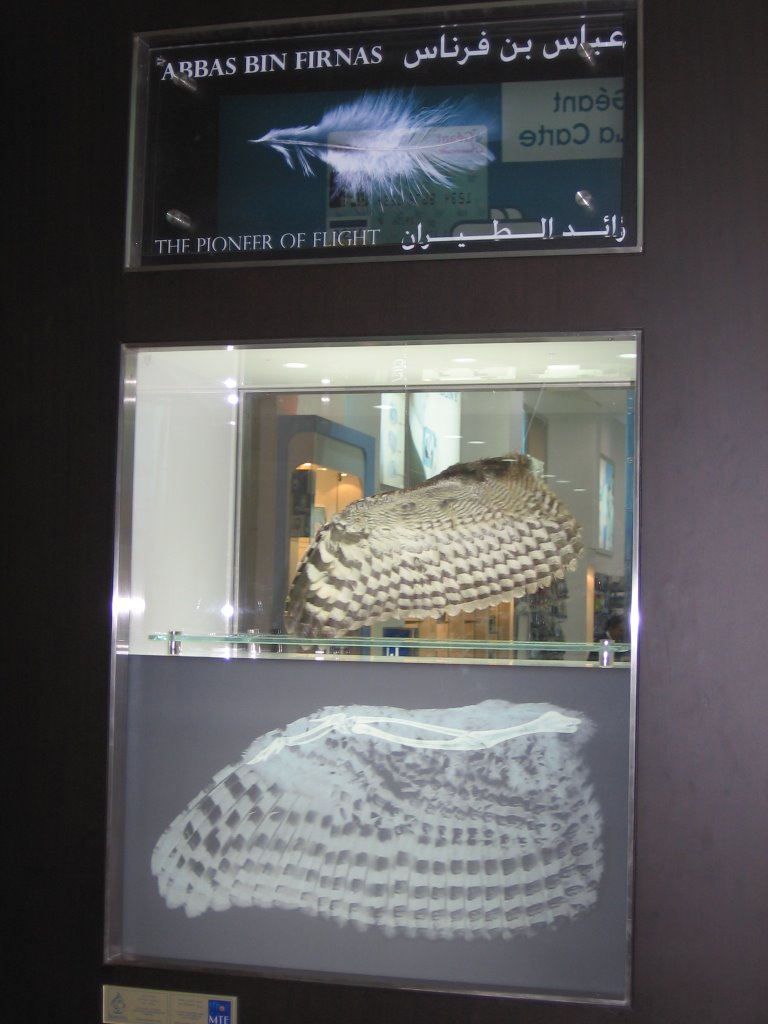
In Andalucia you can find out about Abbas bin Firnas who, in the late 800s, at the age of 70, strapped on a pair of wings and stepped off a cliff near Cordoba. And lived!


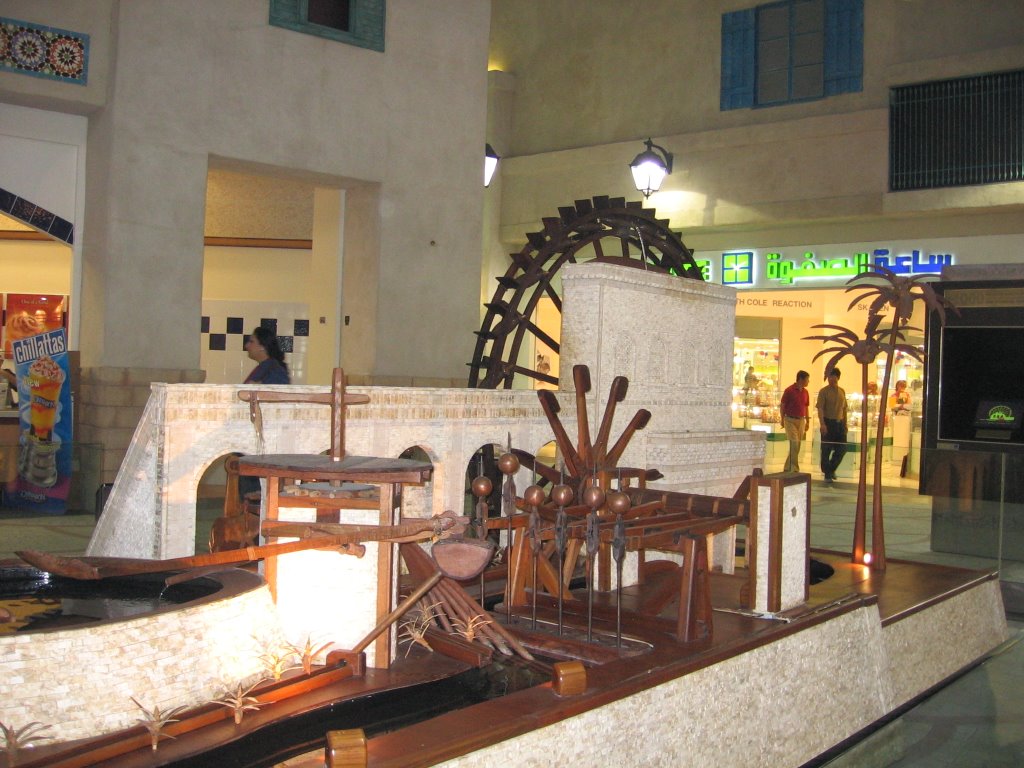
This fantastic model of an irrigation system is in Tunisia - between the food court, Gloria Jean's and Cinnabon, in case you're worried about your blood sugar on your long trek across time and continents.


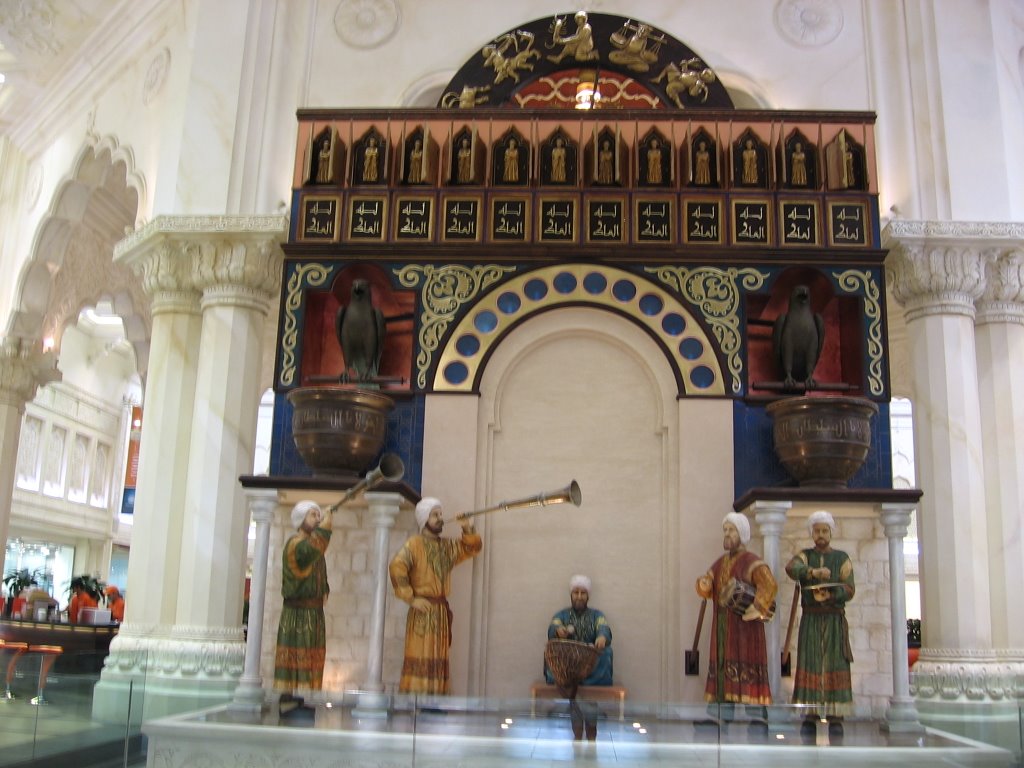
This wonderful clock is in the big India court, separated from the elephant clock by the seductively squishy orange banquettes of Cafe Havanna. (There's a reason I never lose weight, no matter how enthusiastically I hurl myself about at the gym.) The figures on the right are supported by wooden levers to enable them to mark the hour.

This is only a fraction of what's on show. I am so impressed by the range and attention to detail on this exhibition. Excellent.

Tuesday, May 09, 2006

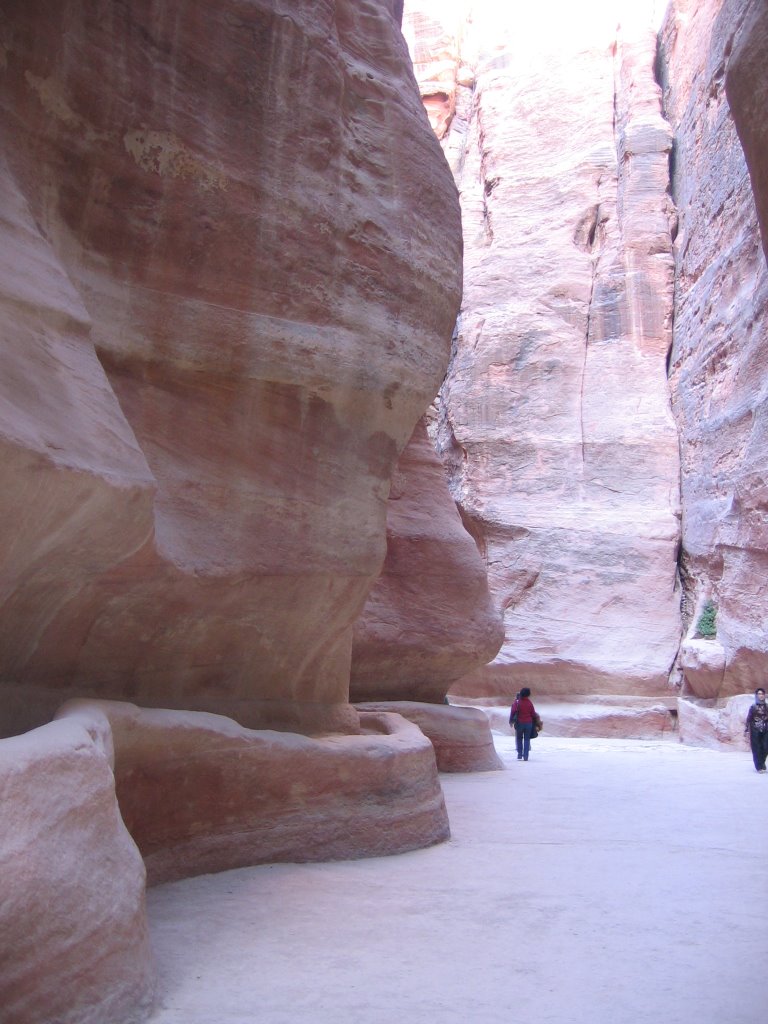
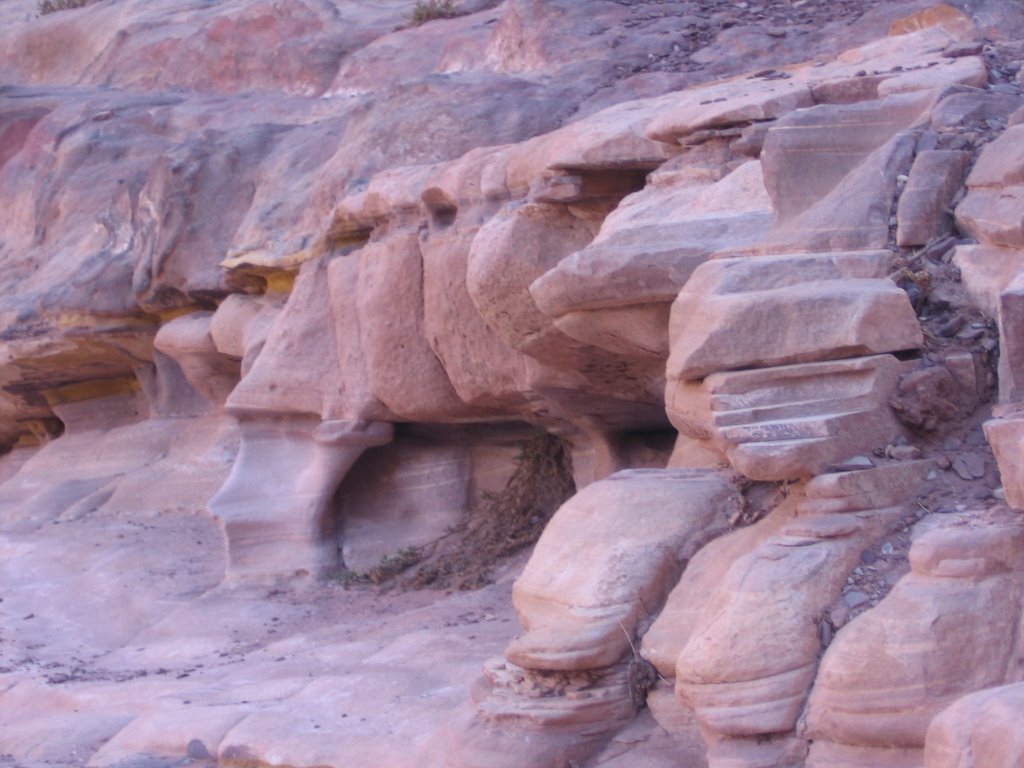
Gaudi in Petra?


Finally, a portrait of Habibi and Habibibaba. Handsome, huh?

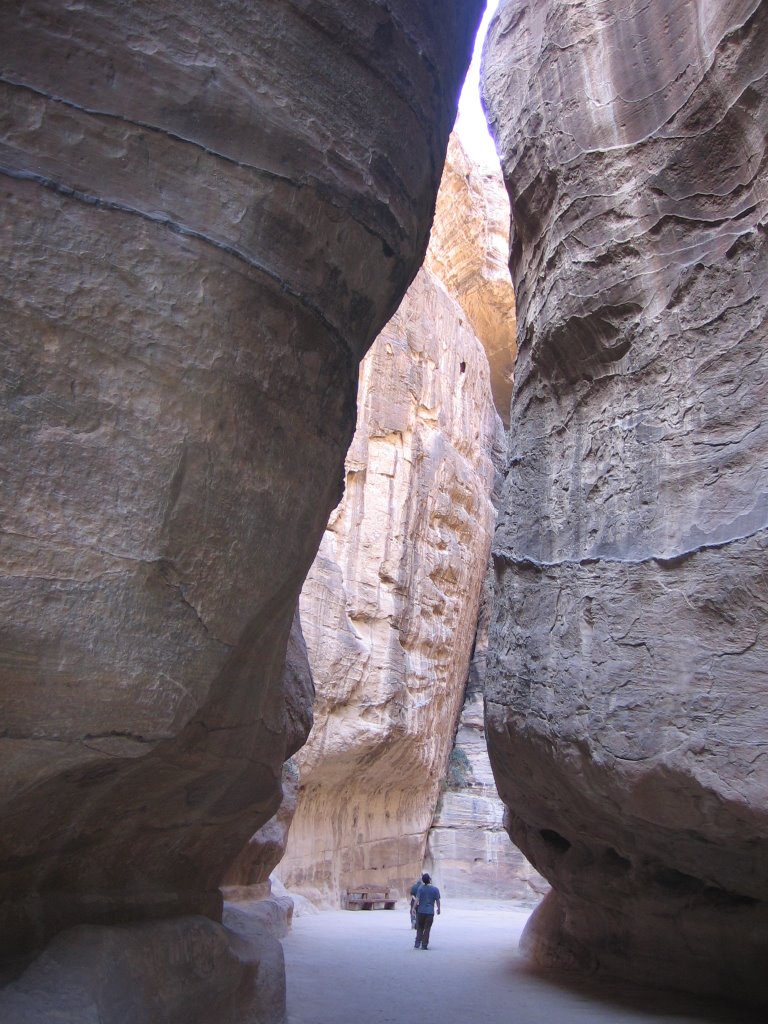
This was quite a warm day, but the Siq was cool. Hey it was awesome! :D

The scale. Absolutely not to be compared with the experience of walking between two office towers, unless Gaudi did some.


Guidebook note: In Hellenistic and Roman times, Petra was the capital of the Nabataean Kingdom (4th century BC - 106 AD) and became a major caravan centre.

The Nabataeans traded in the perfumes of Arabia, the silk of China and the spices of India, and carried these goods to Gaza and Alexandria. The Nabataean King Aretas III controlled Damascus.

(If you want any more, go visit and buy 'JORDAN, tracing 4000 years of history, publ. Plurigraf)

And the trough at the base of the rock face is a water channel which would once have held 'ceramic tubing [which] carried fresh water from Ain Musa to the city' (more guidebook). Wow. Still thinking Gaudi here.


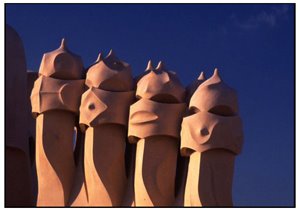
Gaudi's House, Barcelona


Is anyone else reminded of Imperial troops and anthropomorphic desert troop carriers in the Star Wars - er - sexology? - ?


When we were in Barcelona last summer, we went to Parc Guell, walked round the outside of La Sagrada Familia (fin-de-vacances cheapskates) and I spent a satisfying half day following the map from one Gaudi building to another. Of course, right now I don't know where I've tidied my Barcelona memorabilia, but in the course of Googling for non-copyright images - or at least, not for the ones that someone's trying to earn a living from - I found the chimney pots on Haabaa blogs. It's an interesting general interest blog with entries in English, Spanish and Polish - often translated from one to another, which is good for us flaky Spanish students!

Friday, May 05, 2006

Israel & Palestine - my twopennyworth

Keefieboy's Democracy entry generated a very serious debate on the rights and many wrongs of the Israel/Palestinian situation. Now I’d like to add my thoughts, but Keefieboy’s had enough, so I’m putting it on my blog. I hope that's ok?

Bandicoot said: I’m a bit disheartened at how other bloggers seemingly decided to stay out of this (assuming anybody is reading our posts).... [W]ith very little chance that either one of us would experience a dramatic change in their minds and stands......... I believe we’re testing our ideas in a public forum of sorts, as we argue back and forth, forcing us and others to think and rethink this stuff. This I thought would’ve attracted few more people to participate, but unfortunately this doesn’t seem to be the case.

Bandicoot and Tim - I for one have 'stayed out of this' because I have nothing to contribute except cheers for the fact that you both speak so thoughtfully and passionately from your own knowledge and understanding of a situation which matters to me, but also baffles me.

The books you quote, Bandicoot, are not in local bookstores as far as I am aware; and to find for myself the sites you cite (!) takes me through so many hideous, heartbreaking, rage-filled propagandist sites for both sides that I quit. I have followed your debate to learn, and have not interrupted because I didn't want to distract. I suspect that there are many more like me.

Keefieboy said: maybe I don't really know anything about Hamas. I think that not many of us foreign nationals do, really, beyond the balaclavas and bombs.

For my part, I knew nothing about Hamas's grassroots community work, their hands-on support for families living for years with unimaginable, and largely unreported, deprivation, until the election campaign began, and it was mentioned in a TV report on Hamas's appeal. To me, they were desperately misguided extremists; by no means justified in their suicide bombs, but a predictable product of generations of repression, and the extinction of hope for any kind of normal life through any other means. To Palestinian voters, however, they were a group with a track record of social action, and an alternative to a regime whose complacency, croneyism and corruption had long since leeched its credibility.

Anonymous said: People are being killed daily, prohibited the right to learn, to eat well. [W]here are the human rights now?

Bandicoot referred to: Israel’s policy of demolishing the homes and bulldozing the livelihood of thousands of Palestinian families.... of detaining Palestinians indefinitely without trial, wide-spread abuse and racism... and officially-sanctioned torture and assassination, and made what to me seems the obvious point that: Decades of daily humiliation, routine violation of basic human rights, and systematic brutality will not produce a nation of Buddhas! People who knew the reality of the Occupation, including many foresighted Israelis, warned repeatedly that the gross injustice of Israel’s military rule will only degrade the humanity and morality of both occupier and occupied. Their words couldn’t have more prophetic.

Tim Newman responded with: I flatly refuse to view the deliberate mass murder of civilians by terrorist militias in any context. It is inexcusable, period. echoing Keefieboy's any 'political' organisation that uses violence as a means to an end is a terrorist organisation in my book. That includes the likes of the IRA, ETA, Tamil Tigers etc. They may have legitimate arguments and claims, but bombing innocent people is 100% not the way to pursue those arguments, as both the IRA and ETA have now conceded.

Yes, it's inexcusable, and, as everyone eventually concedes, ineffective. Except: governments which use terror often win, at least for a time.

It's a matter of resources, ruthlessness, and connections. If you've got a big 'defence' budget; a social control network in which intelligent, educated and amoral strategists work with ambitious career executives to control and direct education, the judiciary, national media, international lobbyists, and the energies of large numbers of well-armed, semi-literate, underpaid, testosterone-fuelled sociopaths whose idea of a good day's work, or a good night off, includes rocket attacks, kidnap, rape, massacre, looting and arson; coupled with the de facto support of other governments either reluctant to criticise for fear of jeopardising their own interests; or defeated by the compexity or longevity of the situation - well, you have a very strong hand against internal dissent (or should I say ‘democracy’?).

A hand like that, well-played, can keep a system, incumbent or dynasty in power for a very long time. Stalinist Russia, Maoist China, Ceauşecu, Amin, Mugabe, Pinochet etc. etc. etc.

A reign of terror is generally more effective if it's managed quietly, through a system in which people are ‘re-educated’ à la USSR or China or simply 'disappear' à la Latin America. You can get away with that for decades, generations even, especially if you’re big. Blatant massacre à la Janjaweed Militia tends to stir international outrage, but if you don’t mind, then it don’t matter. Political assassination by helicopter gunship à la Israeli Army also upsets people, even your friends; but if your ‘friends’ are rather nervous of the potential political fall-out from falling out with you – you can probably get away with that sort of thing for decades too.

Amnesty International and the United Nations do their best and have their successes, but velvet and rose revolutions may only be possible when a weaker dynastic or political generation coincides with the emergence of an individual who can unite and inspire a population otherwise numbed by oppression.

Candidates for this position should offer a broad education; good health; integrity, vision and moral and physical courage; charisma; emotional stamina for the long haul through national optimism, triumph, impatience and disillusionment; a gift for detail; recognition of their personal limitations; the ability to recognise and retain honest and talented colleagues; bone-deep belief in social justice, the rights and responsibilities of the electorate; and no dynastic ambitions whatsoever. Those afflicted by inferiority, persecution or messianic complexes, or a belief that what this country needs is military discipline, need not apply.

Long term political stability and economic development, in a social and political environment which respects individual freedoms, are far more difficult to achieve if the population has been denied proper nutrition, healthcare, education and employment opportunities for more than a generation. If, in addition to this, funerals have been a regular part of their community life for as long as they can remember, in communities where everyone is related to almost everyone else by blood or marriage, the emotional under-swell is unfathomable and, it seems to me, one of the greatest obstacles to social cohesion and stability. The sad, sad, ultimately hopeless need to make sense of violent death, to believe that someone precious ‘did not die in vain’, to use a hackneyed phrase, lies weeping in the way of any peace process, but most especially after ‘civil’ war.

How does either side forgive? How can you call it ‘quits’, shake hands, and start again? Those bastards killed your husband, your wife, your mother, your cousin, your eighteen month-old grandson. Because of them your daughter does not speak anymore, your four year-old draws nothing but APVs and explosions, your eleven-year old is more interested in throwing stones at soldiers than playing football, and your sixteen year-old has a look in his eyes that makes your heart go cold.

Melodramatic? Composite. And real.

Where does forgiveness start?
What do we do with the primal need to make someone pay?
How do we trust people who would do what these people have done: these Palestinians, these Israelis, these Catholics, Protestants, Muslims, insurgents, Americans, British, Tamils, Basques, these government forces?
Why should they have their independence, their territory, their self-determination, their theocracy, their democracy, their international support, their reconstruction grants, their control of oilfields, gas reserves, water supplies, fertile land?
Why should they get what they want when we have suffered so much, and been condemned because we had to fight for our survival as human beings?

To outsiders what looks like a bloody-minded rage for revenge, an irrational, barely human, urge in those people to perpetuate a cycle of death, begins to look a little different if someone of ours comes home in a box, if at all, after a landmine, a drive-by shooting, a suicide bombing. Then, what price forgiveness, justice, a rational appraisal of the most positive way forward?

To return to Tim: I flatly refuse to view the deliberate mass murder of civilians by terrorist militias in any context. It is inexcusable, period. Putting such acts into context gives them a veneer of acceptability that I do not believe they should ever be granted.

I agree that it’s inexcusable, but I think that we do have to recognise context, not to impart any spurious respectability, but to acknowledge the agony and desperation that produce these inexcusable actions, because it seems to me that that’s part of how we can contribute to any peace process.

Part of the difficulty facing foreign diplomatic agents in the Middle East is the perception that we’re all part of the Greater United States, and Zionists to boot. Of course, this is the line that Ahmedinejad, Osama bin Laden and Al Zarqawi promote, and which is probably peddled assiduously in Islamist mosques throughout Asia, the Middle East and the parts of Europe where Muslim immigrants are evidently nursing grievances of their own.

From Anonymous: Why do you look at dead Israelis and read their stories, but not even spare a moment to learn all the stories behind Palestinian deaths?

With respect, not true, or at least not entirely.

These stories are in the papers, and on the Internet, and people read them.

International channels and newspapers do generally aim for balance. Owners’ political agendas affect the appointment of editors, which of course affects both what is reported, and how it is reported. BUT – (big but!) we have a choice of newspapers in all the major languages, and these days, a remarkable number of people are fluent in two or more languages. There are British papers I would not use to line the garbage bin with, but others I trust and greatly enjoy. I make a point of following domestic and international news stories on both British and American news channels, not just to rule out editorial bias, but also to get the mood of the society they are reporting from and to. (The US is as foreign to me as any other country.) And I’m basically quite lazy about this: many more non-Arabs and non-Muslims try very hard to get to the truth; and to be fair, the reputable western national dailies aim to provide that, along with balanced editorial comment and background information.

No, not everyone reads deeply or regularly – but many do, because we want, we need, to know, to try and figure out what’s going on. Why else would we blog about all this? Why have Tim and Bandicoot gone back and forth on this for days on end? I quoted Bandicoot on that at the outset: we’re testing our ideas in a public forum of sorts..... forcing us and others to think and rethink this stuff..

Sure, there are racist bloggers, but they tend to limit themselves to pathetic kneejerk insults in other people’s comment blogs. I think you, Tim and Bandicoot are better than that. I know I try to be.

The creation of the State of Israel through the breathtakingly arrogant meddling of the United States, Great Britain et al, was a colonialist’s solution to an ancient wrong – the deportation of the Jews and erasure of their homeland, as an entity, by the Romans; plus an ongoing injustice – the anti-semitism which has pervaded European society since the Middle Ages; and of course, a specific disaster - what we would now term a crime against humanity, i.e. Hitler’s attempts to finish what the Romans started, by erasing the entire race of Judah from his patch. Iran and the Arab nations can dispute all they wish, but the Holocaust happened, and 6,000,000 Jews were exterminated. Accepting that is not a step towards accepting that what was done to Palestine was justified.

The Holocaust did not, and does not, excuse the displacement of 300,000 Palestinians to make room for a new State of Israel. Nor the subsequent actions of the Israeli government as quoted by Bandicoot. It is bitterly ironic that Jews, Arab Muslims and Arab Christians were rubbing along quite comfortably until then. Live and let live.

I also find it ironic that, at a point when Crusades, anti-Jewish legislation, Jew-baiting, and pogroms were receding into history, (salutary examples of our inexhaustible ability to make scapegoats of others); just as America was benefiting from the culture and skills of the second-and third- generation descendants of 19th and 20th Century refugees from European anti-Semitism; and the Wandering Jew of legend was discovering that the New World, the Land of the Free, might just possibly be his Promised Land too; when Europe and America was awash with guilt about what had been allowed to happen in Germany and Poland, and Jewish stock had probably never been higher (Er, no, I don’t imagine for a second that we were all about to live happily ever after in harmonious diversity. Come on!!) – at this point, in a mess of good intentions, political expediency, moral cowardice and paternalistic WASP blindness to the reality and validity of foreign cultures, Uncle Sam and his buddies orchestrated a folly only Dubbya could surpass.

We all live with the legacy of that decision. The world hugs itself with fear. But what’s done is done, and Israel is a sovereign state. Nor is that going to change, in my estimation.

When, in 1967, Israel’s Arab neighbours surrounded her and attempted to wipe her off the map, she fought back with everything she had, beat them off, and has continued to hold them off ever since.

Throughout history, the Middle East and North Africa have seen migrations and invasions, and the rise and fall of cultures. In modern times, English is spoken widely in the Middle East; many citizens of post-colonial North Africa are bilingual in Arabic and French, Portuguese or whatever; and there is other evidence of European influence; even so, no European country has successfully conquered any of these Arab states, or displaced their culture or religion. Arab society is built on community, and a sense of community is built on generations of continued occupancy of land. People are connected through their relationships with each other and their land. From this they draw their sense of who they are. Real estate is a western capitalist concept. Land is different. People hold onto their land.

It seems to me that the insertion of Israel into Palestine is both the exception to and a confirmation of this precept, and the key to the Palestinians’, and their neighbours’, inability to oust the Israelis (disregarding US economic, technical and diplomatic support) lies partly in the fact that some of the pre-Israel population was Jewish, and this was indisputably their land.

More important though (in my opinion), is the concept of ‘The Promised Land’ among the diaspora, and the fact that, as contemporary expats and first generation immigrants do everywhere, they kept their sense of self in foreign countries by retaining their customs and culture. Had they fully integrated into European life as immigrants eventually do, embracing their new home, things might have been very different; but having lost their actual country, and finding themselves the despised ‘killers of Christ’ in Europe, perhaps the only way to hold on to their identity and self-respect was to hold on to the culture that bound them together. A defence mechanism which only further emphasised their difference in aggressively Christian Europe, both before and after the Reformation.

Emotionally, spiritually, culturally, home was Palestine. And so in 1948, having had absolute proof that anti-semitism was alive and well in the modern world, Jews did not head for Israel as invaders or colonists: they went home. Being loathed and despised by their neighbours, being legislated against, insulted and assaulted, was nothing new. The Wandering Jew had returned to the Land of Israel, promised to Moses by God, and, by God, would stay.

Palestine belongs to the Palestinians.
Israel belongs to the Israelis.
Sixty years of Israeli oppression have not altered Palestinian determination to get their homeland back.
Sixty years of Palestinian resistance culminating in the Intifada have not changed Israeli determination to hold on to their homeland.

Both sides have committed disgraceful crimes for which their God will no doubt hold them to account. But if both sides are prepared to spend 60 years in a living hell of bloodshed, fear and mistrust, to bring up embittered children brutalised by modern guerrilla warfare, to face international condemnation for their actions, and can still square their consciences with their God, then it seems to me that neither is ever going to move out.

There will be no weary surrender from either side, and neither will ever – ever – know peace and freedom unless they are brave enough, strong enough, godly enough, to agree to disagree, to hammer the swords into ploughshares, and to develop as fair a division as possible of that stretch of land into two parallel states.

It is going to be very very hard. For many, compromise betrays the efforts of those now dead; but surely intransigence condemns the living to lifelong misery and fear, and betrays those not yet born.

Monday, April 24, 2006

A Blog for St. George

I clean forgot til I popped over to Grumpy Goat's blog (magnificent profile!) that yesterday was St. George's Day.

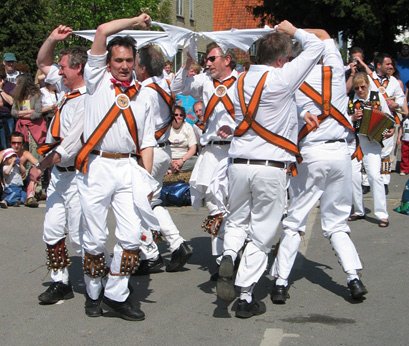
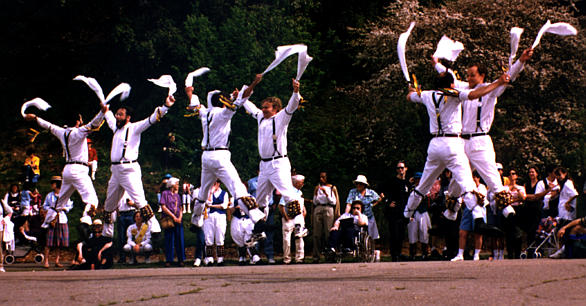
We used to live in a village in the northwest of England. Once a year, on the nearest Saturday to April 23rd, we used to celebrate A Day for St George, when teams of morris men would come from miles around to dance through the streets (and the 11 pubs) waving hankies and handing out fertility cake. It was always a lovely, relaxed, giggly sort of day, and the sun usually put in an appearance at some point, and only an occasional token wetting.

Our morris men practised weekly at the community centre, on Tuesday evenings at 9 p.m. I remember this because when Habibibaba was about five, he was completely enchanted by them one St George's Day, and declared that he wanted to be a morris boy So I took him to a practice.

The men were very sweet about this (Ha! I just thought! Morris Minor! Yay! OK sorry, forgot my medication.) and let him stay, and taught him some steps. He had a lovely time, and never mind that I didn't have a camera. I have to confess though, to blighting my son's initiation into male ritual, because I, I mean he, couldn't stay up so late and get up for school the next day. Shame.

Our village was in the process of becoming part of a conurbation, with ribbon development the length of both top and bottom roads from Bolton, but it still had its pubs, and folk club, and local events in the schools, the community centre and the leisure centre. We had good friends there, and were happy.


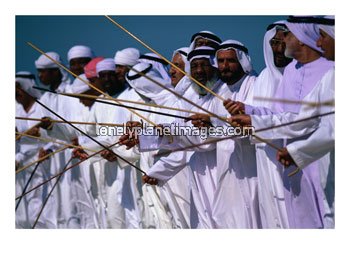
By the way, it's always been said that 'morris' derives from 'moorish' referring to gypsy entertainers who travelled across Europe in the Middle Ages. When I got here, and saw men in white linking arms and waving a handkerchief as they performed the dybbka, I realised it was probably true.